What Does the Ascendant Line Mean in Astrocartography? A Complete, Human Guide
A deep guide to the most personal line on your astrocartography map. The Ascendant line shapes your identity, physical presence, and first impressions in every place you travel to or live in.
Written by AstroChart Team

There's a specific moment I want you to remember.
You step off a plane in a city you've never been to. The air smells different. The light hits at a different angle. And something in you — posture, voice, the way you hold your shoulders — quietly rearranges itself. Strangers look at you twice. You say yes to something you'd usually decline.
That shift has a name in astrocartography. It's called an Ascendant line (or ASC line for short), and it's one of the most personally transformative lines on your entire map.
If you've been trying to understand what the Ascendant line means in astrocartography — beyond the one-sentence definitions most websites give — this guide goes deep. No template summaries. Just the mechanics, the meaning, the lived experience, and the decisions it helps you make.
📖 What you'll learn in this guide:
- What the Ascendant line actually represents (and why identity is not the same as personality)
- How ASC lines differ from MC, IC, and Descendant lines
- Why your Ascendant line curves across the globe instead of running straight
- What each of the 10 planets does on your ASC line
- What it feels like to cross or live on your Ascendant line
- How to find yours and when to choose it over other lines
The Ascendant Line in 30 Seconds
Short on time? Here's the compressed version.
The Ascendant line (ASC line) shows the places on Earth where a particular planet was rising over the eastern horizon at the exact moment you were born.
Living near or visiting one of your ASC lines subtly reshapes how you show up in the world — your physical presence, your sense of self, the first impression you leave.
It's the line of identity and visibility. Where the MC line asks what do you do?, the ASC line asks who do you become?
Your ASC lines are the curved ones on your astrocartography map — generate it free to follow along.
What the Ascendant Line Actually Represents
Most explanations stop at "the Ascendant line governs identity." That's accurate but shallow. Here's what it actually does, broken into three layers.
Identity, Not Personality
Your personality is relatively fixed. You can move across the world and you'll still have the same sense of humor, the same fears, the same strange relationship with authority.
Identity is different. Identity is the edited version of yourself that you project into a room — and it's surprisingly fluid. On a Jupiter ASC line you might find yourself volunteering opinions you normally keep to yourself. On a Saturn ASC line you might walk slower, speak later, feel older in a good way.
The Ascendant line doesn't change who you are. It changes which part of you gets to walk in first.
How Others Read You Without You Speaking
Somewhere between 70 and 90 percent of first impressions happen before anyone opens their mouth. Clothing, gait, eye contact, the energy of your presence. The ASC line is the astrocartography equivalent of that nonverbal signal.
A client of mine once spent six months in Istanbul, which sits roughly on her Venus ASC line. She didn't change her wardrobe or her hair. But every person who met her there described her first as "elegant." Nobody had ever led with that word before. She came home and compared photos, and the Istanbul ones really do read differently — softer around the mouth, more open in the eyes.
That's an ASC line doing its quiet work.
A Body That Fits You Differently
This is the part astrology books undersell. The ASC line affects your relationship with your own body.
On a Mars ASC line you may sleep less and recover faster. On a Neptune ASC line your dreams intensify and your digestion slows. On a Pluto ASC line you might notice a strange magnetic density in your presence — people step closer or farther away than usual, and you feel it.
None of this is metaphor. Physiology responds to place, and the ASC line is where the response is loudest. If you've ever moved and felt your body "settle" or "refuse" a location before your mind caught up, you were probably crossing or leaving an Ascendant line.
How the Ascendant Line Is Different from MC, IC, and Descendant Lines
Astrocartography gives every planet four angular lines. They answer four different questions about the same location:
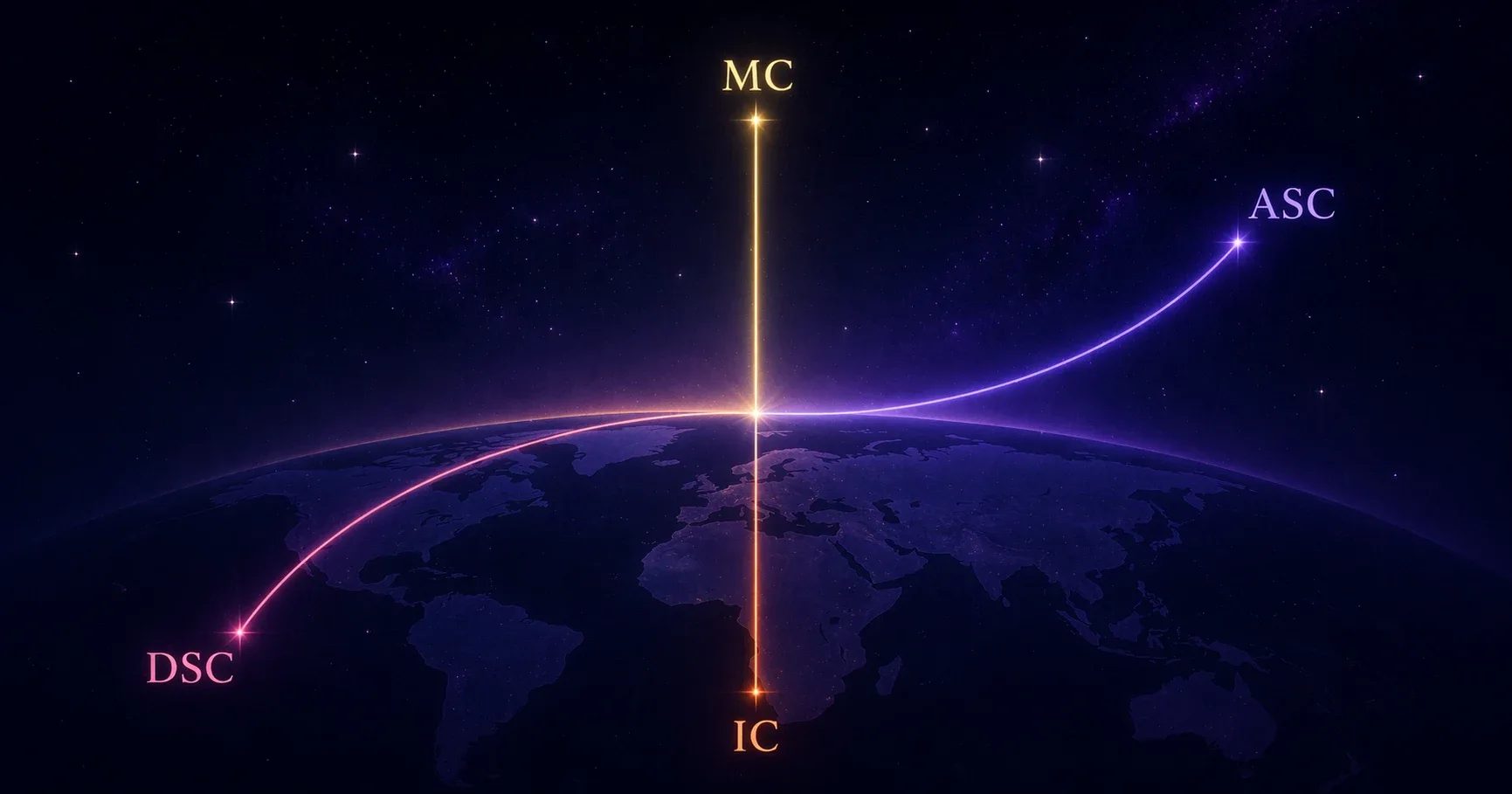
| Line | Core Question | Life Area |
|---|---|---|
| Ascendant (ASC) | Who do I become here? | Identity, body, visibility |
| Midheaven (MC) | What do I do here? | Career, public reputation |
| Imum Coeli (IC) | Where do I belong? | Home, roots, private life |
| Descendant (DSC) | Who do I meet here? | Partnerships, one-to-one relationships |
Notice something? The ASC line is the only one that points back at you. The other three describe what happens to you, or around you, or because of you. The Ascendant describes what you become.
This matters for a practical reason. If you're thinking about travel or relocation and wondering which line to prioritize, the question to ask yourself is: "Do I want to do something different, or do I want to be different?" Different answer, different line.
A related confusion I see often: the four angular lines are not ranked. A Venus DSC line isn't better than a Venus ASC line — they do different jobs. I've watched people skip their ASC lines entirely because they'd read that DSC was "better for love," and end up in a relationship where they felt invisible. The Venus ASC would have made them the attractive one. The Venus DSC made them someone attractive people date.
Why Your Ascendant Line Curves Across the Map
Here's a question almost nobody answers. Why do MC and IC lines run as straight vertical lines on an astrocartography map, while ASC and DSC lines curve?

The short answer: geometry.
At any given moment, a planet at the Midheaven is directly overhead for one line of longitude. That's a straight north-south line, and it stays straight no matter how you project the Earth onto a flat map.
But a planet rising on the eastern horizon looks different at different latitudes. In Reykjavík, Venus might rise at a shallow angle. In Nairobi, the same Venus rises nearly vertically. Connect all the places on Earth where Venus is rising at your birth moment, and you get a great circle — the same kind of curve you see on long-haul flight paths.
When that great circle gets flattened onto a rectangular world map, it bends. That bend is your Ascendant line.
Practical takeaway: two cities at the same longitude can sit on completely different sides of your ASC line. Birth latitude matters here more than it does for MC and IC, which is also why birth-time precision matters more for ASC interpretations than for any other line.
What Each Planet Means on Your Ascendant Line
Ten planets, ten different versions of "you" that can step forward in a location. These summaries are deliberately short — the deeper work happens when you combine your ASC line with the rest of your natal chart.
I've split them into three layers:
- Personal planets — how you show up day to day
- Social planets — how you build, commit, expand
- Outer planets — how you transform, often without asking
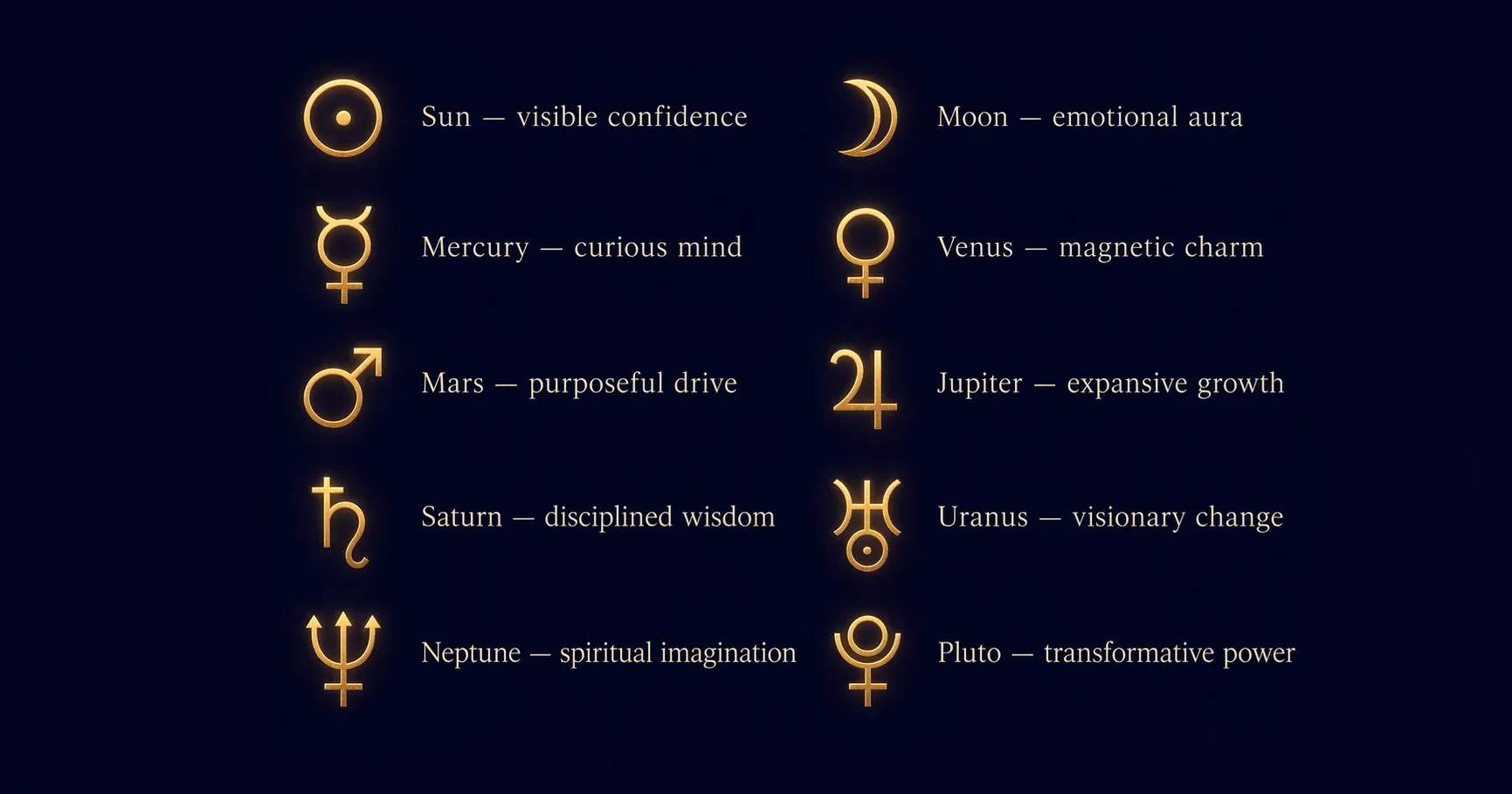
Personal Planets: The Daily You
These five shape how you move through a given day. Their effects come in fastest — usually within the first week after you arrive.
☀️ Sun on Your ASC Line
You arrive and you are seen. The Sun ASC line turns up your visibility, confidence, and natural authority. Rooms orient around you, sometimes without you wanting them to.
🌙 Moon on Your ASC Line
Something softens. People share private things with you within an hour of meeting. You become emotionally legible — your face tells the truth before your words do.
☿ Mercury on Your ASC Line
Your voice speeds up. You're funnier, quicker, more verbal. People read you as younger than you are.
♀️ Venus on Your ASC Line
This is the charm line. You look different in photos, and not just because of good lighting. Your body relaxes into a softer posture. Doors open that weren't opening before.
♂️ Mars on Your ASC Line
You wake up ready. Physical energy surges, competitiveness sharpens, and your threshold for excuses drops. This is the line where you finally start the thing you've been stalling on.
Social Planets: What You Build
Jupiter and Saturn work on longer timelines. You feel them most when you stay somewhere past the honeymoon phase.
♃ Jupiter on Your ASC Line
Everything feels slightly easier. You take up more space — sometimes physical, often social. Opportunities find you through people who already liked you. See our deep dive on Jupiter lines for career growth.
♄ Saturn on Your ASC Line
People take you seriously here. Your face holds its own gravity. If you're young, this line makes you feel older in a clarifying way; if you're older, it gives you the authority you've earned. Saturn lines are often misread as "bad" — they aren't.
Outer Planets: Who You Become
Uranus, Neptune, and Pluto don't care about your plans. They work on your deep identity — often painfully, usually permanently.
♅ Uranus on Your ASC Line
You become the unexpected one. Hair changes. Style changes. You say things in meetings that nobody saw coming, and sometimes the room laughs, and sometimes it doesn't.
♆ Neptune on Your ASC Line
Your edges blur. People project their hopes and fantasies onto you. Dreams intensify. Creative flow becomes easier, and so does confusion.
♇ Pluto on Your ASC Line
You become unmistakable. The Pluto ASC line doesn't do neutral — it intensifies every signal you send. People either orbit you closely or avoid you entirely.
What It Actually Feels Like to Cross Your Ascendant Line
This is the question I wish more astrocartography guides answered. Not "what does it mean" in the abstract, but what happens in your body and in your week when you actually land near one.
The First 24 Hours
Most people notice something in the immigration queue. Not mystical. Physical. A change in muscle tone around the face, a different resting heart rate, a kind of mental quieting or brightening depending on the planet.
One client described her first night on her Jupiter ASC line like this: "I slept ten hours and woke up laughing at something I couldn't remember." Another, on her Saturn ASC line, cancelled her evening plans and sat in her hotel room reading a physical book — which she hadn't done in years.
The First Week
By day three or four you usually notice the social feedback. Strangers interact with you differently. A Venus ASC traveler gets offered better tables. A Mars ASC traveler wins an argument with a cab driver, calmly. A Neptune ASC traveler loses track of time in a museum and can't quite explain the afternoon to anyone when they get back.
None of this is dramatic. It's subtle. But it's consistent enough across hundreds of client reports that I stopped dismissing it years ago.
Living There Longer
Living on an ASC line is different from visiting one. The identity shift becomes less novel and more structural — you start making choices that match the new version of yourself. Career pivots. Relationship changes. A different haircut, worn for years.
At that point the line isn't giving you an experience. It's giving you a life.
How Far the Ascendant Line's Influence Reaches
You don't need to stand on the line to feel it. The influence radiates outward, and it fades with distance.
| Distance from line | Strength | What you'll typically notice |
|---|---|---|
| 0–150 km | Very strong | Unmistakable identity shift within hours |
| 150–300 km | Strong | Clear pattern changes within days |
| 300–500 km | Moderate | Background influence; subtler but real |
| 500+ km | Weak | Fading; may still activate during transits |
Two extra things to know. First, orbs are wider for outer planets (Saturn, Uranus, Neptune, Pluto) than for inner ones — you can feel a Pluto ASC line from farther away than a Mercury ASC line. Second, line crossings — where an ASC line meets another angular line from a different planet — create hot spots where the orb effectively doubles. Paran line crossings are worth checking for any location you're considering seriously.
Ascendant Line vs Relocated Ascendant: Clearing Up a Common Confusion
If you've read a few astrocartography articles, you've probably seen both terms used — sometimes interchangeably, sometimes in contradictory ways. Here's the difference, stated plainly.
Your natal Ascendant is the zodiac sign that was rising on the eastern horizon at the exact moment and place of your birth. It doesn't change. Ever. It's yours for life.
A relocated chart (sometimes called a relocation chart) recalculates that same birth moment as if you had been born in a different location. The planets stay in the same zodiac signs, but the houses rotate, so your rising sign changes. Under this view, someone born with a Cancer Ascendant in London might have a Virgo relocated Ascendant in Los Angeles.
Your Ascendant line on an astrocartography map is a third thing — not a recalculated sign, but a visual line showing everywhere a specific planet was rising at your birth moment. The planet on that line (say, Jupiter) is what reshapes your self-presentation in those places.
These three ideas describe the same underlying reality from three angles. Your natal Ascendant says what you're made of. Your relocated Ascendant says what sign-flavor your life wears in a given place. Your planetary ASC lines say which planet walks in the room with you.
How to Find Your Ascendant Line on a Map
Four steps, and you're done in about two minutes.
Step 1 — Generate your map
You need three things: exact birth date, exact birth time, and birth city. Our free astrocartography calculator handles the rest. A four-minute error shifts your ASC line by roughly 111 kilometers.
Step 2 — Find the curved lines
ASC and DSC lines are the curved ones. ASC lines curve from the eastern horizon. DSC lines curve from the western side. Most calculators color-code them by planet.
Step 3 — Check which planet
Each ASC line is labeled with a planetary glyph. Start with the planets you already know something about in your natal chart — they'll feel familiar in a new costume.
Step 4 — Measure the orb
Check how close the location you care about is to the line. Use the distance table above to estimate strength.
When to Choose an Ascendant Line Over MC, IC, or DSC
You can build a rough decision tree around one question: what kind of change am I trying to make?
| If you want... | Prioritize this line |
|---|---|
| A new public reputation or career breakthrough | MC line (Jupiter or Sun MC, usually) |
| A sense of belonging, emotional grounding, or family healing | IC line (Moon IC, often) |
| A new serious partnership or mentor | DSC line (Venus or Saturn DSC) |
| To become a different version of yourself | ASC line |
The ASC line is the correct answer when your problem isn't circumstantial. When you've tried therapy, fresh starts, new jobs, new gyms — and you still carry the same quiet feeling of being the wrong shape for your own life — that's when geography can help. The ASC line relocates the doorway you enter rooms through.
It's the wrong answer if what you actually need is a raise or a partner. Don't use the ASC line to fix what an MC or DSC line could fix more directly.
One pragmatic note: you can visit an ASC line without moving. Two weeks near a strong ASC location is often enough to reset a pattern, especially if you go in with a specific intention. I know people who make Venus ASC pilgrimages annually and come back a little different each time.
Frequently Asked Questions
Quick answers to the questions readers ask most. Click any question to expand.
What does the Ascendant line mean in astrocartography?
The Ascendant line (ASC line) marks every place on Earth where a specific planet was rising over the eastern horizon at the exact moment you were born. Living near or visiting one of these lines reshapes how you show up in the world — your identity, physical presence, and the first impression you leave with others.
How is the Ascendant line different from the MC, IC, and Descendant lines?
The ASC line affects who you become in a location. MC lines affect career and public reputation. IC lines govern home, belonging, and emotional roots. DSC lines shape partnerships and one-to-one relationships. The ASC is the only one of the four that points back at the self rather than at what happens around you.
How far does the Ascendant line's influence extend?
The strongest influence sits within about 150 km of the line itself. You'll feel clearly noticeable effects up to 300 km away, and subtler background influences up to around 500 km. Beyond that, the effect fades — though transits can temporarily reactivate a distant line.
Do I need an exact birth time for my Ascendant line to be accurate?
Yes — more so than for any other line on your map. A four-minute error in birth time shifts your ASC line by roughly 111 kilometers on the ground. If your birth time is unknown or rounded to the nearest hour, treat your ASC lines as approximate and give them wider orbs.
Does my Ascendant line change my natal rising sign?
No. Your natal rising sign is fixed for life — it's a permanent feature of your birth chart. Your Ascendant lines on an astrocartography map are separate: they show where specific planets (not zodiac signs) were rising at your birth. The two systems describe the same birth moment from different angles.
What happens if two planets share the same Ascendant line on my map?
This is called a conjunction on the ASC, and it creates a blended identity signal. Venus and Jupiter together amplify charm and opportunity. Saturn and Mars together produce disciplined force. Read both planets' meanings and expect a combined flavor, with the faster-moving planet usually dominant in first impressions.
Can I feel my Ascendant line without living there?
Absolutely. Short visits — even a week or two — regularly produce noticeable identity shifts, especially on strong planetary lines. Many people use short pilgrimages to ASC lines as a way to reset a chapter of their life without committing to full relocation.
Is the Ascendant line the best astrocartography line to live on?
There is no universal "best" line. The ASC line is best for people who feel stuck in their current version of themselves and want a structural identity shift. For career or financial goals, an MC line is usually a better bet. For relationships, a DSC line often serves better. Match the line to the question you're trying to answer.
A Final Thought
Astrocartography isn't a magic spell. It's a map of where different versions of you are already possible.
Your Ascendant lines are the ones that ask the sharpest question: not where should I go? but who am I ready to meet in myself? That's a harder question than it sounds. Most of us spend years avoiding it by redecorating instead of relocating, or by relocating and then recreating the same life in a new postcode.
The Ascendant line works best when you arrive with one honest sentence about what you're trying to become, and then stay long enough to let the place hold up a mirror.
That's where the real shift happens. Not in the soil or the air — those are just reminders — but in whoever you've always been, given permission by a new angle of sunrise to finally walk in first.
Want to see your own Ascendant lines?
Generate a free astrocartography map in about a minute — no registration needed for the basic view.
Put this into practice
Ready to Explore Your Astrocartography Map?
Generate your free personalized astrocartography map and discover your ideal locations for love, career, and personal growth.
Generate My Free Map