Pluto in the 6th House
Meaning, Personality & Life Areas
Reviewed by the AstroChart astrology team
Quick Facts
- House
- 6th House — House of Service
- House Type
- Cadent
- Natural Sign
- ♍ Virgo
- Natural Ruler
- ☿ Mercury
- Life Areas
- Work, health, routines
- Transit Time
- ~12–21 years
- Keywords
- Complete commitment to work that mattersA body that reports strain honestlyRebuilds a routine from nothing after collapseSees what is structurally wrong with a systemEndures difficult conditions others leave
Pluto in the 6th house puts the planet of crisis and regeneration in the house of daily work, routine and the body. Nothing here stays ordinary: the job becomes total, the health becomes a subject, and the body reliably registers what the person will not say.
What Does Pluto in the 6th House Mean?
Pluto in the 6th house means work and health are the arena. Jobs are all-consuming or abandoned entirely, routines are rebuilt from scratch more than once, and the body reacts strongly to psychological strain — which makes it an unusually honest instrument.
Pluto in the 6th House Personality & Life Expression
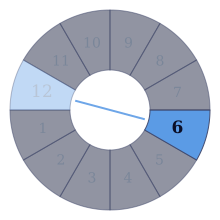
Your Pluto sign is shared with everyone born within about fourteen years of you, since that is how long Pluto spends in one sign. The sign is a generation. The house is what is yours, determined by your birth time — and Pluto in the 6th house is one of twelve possibilities.
The 6th house is the ordinary day: the job as distinct from the career, routines, service, health. Pluto here makes the ordinary day the site of the transformation, which is a stranger idea than it sounds, because it means the large changes in this life arrive through small repeated actions rather than through events.
Work is total or it is nothing. Pluto in the 6th house does not hold a job lightly; it goes all the way in, sometimes to the exclusion of everything else, and then leaves completely when it goes. The employment history is usually short and deep rather than long and steady.
The body is unusually communicative. Pluto in the 6th house somatises — the stress shows up physically before it shows up in words — and the pattern is consistent enough over a lifetime to be treated as information rather than as a nuisance. People with this placement often know something is wrong psychologically because their body told them first.
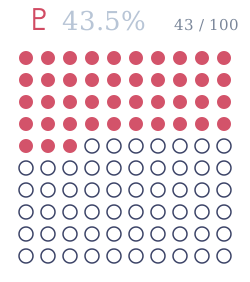
Pluto is retrograde in 43.5% of birth charts — close to one in two — so a retrograde Pluto is not the marking it is generally described as. In the 6th house it turns the scrutiny inward: the person audits their own habits, health and usefulness relentlessly, and is far harder on themselves about a missed day than any employer would be.
The shadow is control through routine. Pluto in the 6th house manages anxiety by regulating the controllable — the diet, the schedule, the workspace, the body — and the regulation can tighten until the life has narrowed considerably without any decision being made. The related failure is work as self-erasure: this placement will disappear into a job for years and call the disappearance dedication.
Strengths
Challenges & Shadow Side
Pluto in the 6th House in Love & Relationships
Pluto in the 6th house shows love through what it does rather than what it says, and what it does is considerable. The practical care here is deep, sustained and often invisible, and this placement will carry a partner through an illness or a bad year without ever describing it as a sacrifice.
The difficulty is that service becomes the whole relationship. Pluto in the 6th house is drawn to people who need something, is genuinely competent at meeting it, and can construct an entire partnership out of usefulness — after which being loved for its own sake feels unfamiliar and slightly exposing.
Daily life is where the power struggles happen. Not the large questions but the small ones: how the household runs, what is eaten, when things are done. This placement has strong views about the texture of an ordinary day and experiences a partner’s different habits as more disruptive than it can reasonably explain.
The pattern to watch is withdrawal into work. When something is wrong here, the hours increase, and the increase is defensible every single time. A partner can spend two years watching someone leave the relationship without ever leaving the house.
In synastry the direction reverses. When someone else’s Pluto falls in your 6th house, they change your daily life and often your health — habits get rebuilt around them, for better or considerably worse. It is one of the least romantic-sounding synastry overlays and one of the most physically consequential.
See it in a chart comparison
Whose Pluto lands in whose house changes the reading completely. Being the one admired and being the one admiring are different positions to occupy.
Open the synastry calculatorCareer & Everyday Life
Pluto in the 6th house does well anywhere the daily work involves crisis, damage or what is hidden in a system. Medicine at the acute and terminal ends, surgery, psychiatry, addiction and recovery services, forensic and pathology work, audit and investigation, occupational health, emergency services, and any operational role where the job is to find what is actually broken.
The working life comes in complete chapters. This placement gives everything to a role, exhausts it or is exhausted by it, and leaves for something unrecognisably different — and the pattern repeats two or three times across a career. Trying to force Pluto in the 6th house onto a continuous linear path produces the collapse it was meant to avoid.
The professional caution is that the body sets the ceiling. Pluto in the 6th house will work past every warning it receives, and the warnings are physical rather than emotional, so they are easy to treat as unrelated. This placement does not respond to advice about balance and does respond to evidence: keeping a plain record of hours worked against symptoms experienced turns an argument it can dismiss into data it cannot.
Pluto in the 6th House Man
A man with Pluto in the 6th house is the one who works harder than the job requires and says less about it than anyone. He is competent under pressure, physically disciplined, and generally carrying more strain than he has disclosed.
His growth edge is treating the body as evidence. Pluto in the 6th house pushes through symptoms on principle and interprets rest as failure, and the reckoning that eventually arrives is expensive. Acting on the first physical signal rather than the third is a small change with a long payoff.
Pluto in the 6th House Woman
A woman with Pluto in the 6th house is usually the one holding an operation together, and the extent of it is rarely visible to the people benefiting. She is exacting, physically self-aware, and unwilling to do anything by halves.
Her work is refusing to be the container. Pluto in the 6th house absorbs the difficult tasks, the difficult people and the difficult hours because it can, and competence of that order attracts more of all three until something breaks. Declining one whole category permanently — not delegating it, declining it — is what keeps the placement a strength.
Pluto Transiting the 6th House
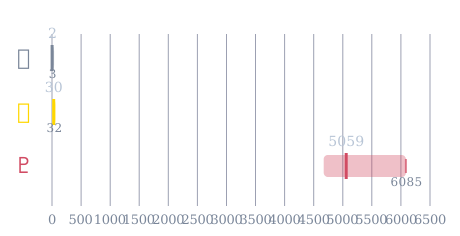
Pluto crosses your 6th house across about 5,059 days at the median — close to fourteen years — and up to 6,085, over sixteen. It is the slow reconstruction of how you spend an ordinary day.
The theme is work and body rebuilt from the ground. A career ends and is replaced by something unrelated. A health matter becomes central and reshapes the routine permanently. Habits held for twenty years disappear, and the daily life at the end of the passage bears little resemblance to the one at the start.
It is frequently the transit in which people change what they do for a living entirely, and often the one in which a chronic problem is either resolved or accepted. Neither happens quickly, which is the nature of the house rather than a delay.
Because your natal Pluto already sits here, this passage is a conjunction to it. Almost nobody lives through a Pluto return, so what you will actually experience are other planets crossing this point — and they reach your working life and your health more directly than they reach anyone else’s.
Blending House & Sign
The house is the personal part; the sign is your generation. Pluto in Virgo in the 6th house — born roughly 1957 to 1972 — is the placement doubled, and this cohort rebuilt the modern relationship between work, health and identity. Pluto in Libra here, 1972 to 1984, works itself into the ground trying to keep a workplace harmonious. Pluto in Scorpio in the 6th house, 1984 to 1995, takes the jobs other people cannot face. Pluto in Sagittarius, 1995 to 2008, needs the daily work to mean something or will not do it at all. One transformed working day, four generations living it out.
Frequently Asked Questions
What does Pluto in the 6th house mean?+
It means work and health are the arena. Pluto in the 6th house holds jobs that are all-consuming or leaves them entirely, rebuilds its routines from scratch more than once, and has a body that reacts strongly to psychological strain — which makes it an unusually honest instrument.
Is Pluto in the 6th house personal, or just generational?+
The sign is generational, since Pluto takes about fourteen years to cross one and is shared by everyone born within roughly a decade and a half of you. The house is the personal part, set by your birth time, making this one of twelve rather than one of millions.
What does Pluto retrograde in the 6th house mean?+
Less than it is generally described as. Pluto is retrograde in 43.5% of birth charts, close to one in two. In the 6th house it turns the scrutiny inward: the person audits their own habits, health and usefulness relentlessly and is harder on themselves about a missed day than any employer would be.
Which house is my Sun in if Pluto is in my 6th house?+
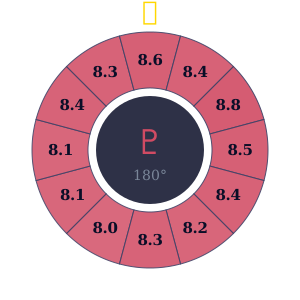
Any of the twelve, at essentially even odds. Across 1950–2026, Pluto shares the Sun’s 30° sector on 8.6% of days and sits opposite on 8.3% — as flat as the Moon’s distribution, because Pluto is distant enough that Earth’s orbit barely distorts its apparent position.
Does Pluto in the 6th house mean health problems?+
It means a body that registers strain early and loudly rather than a body that is fragile. This placement somatises — the stress shows up physically before it shows up in words — and the pattern is consistent enough over a lifetime to be treated as information.
How long does Pluto transit the 6th house?+
About 5,059 days at the median — close to fourteen years — and up to 6,085, over sixteen. It is frequently the passage in which people change what they do for a living entirely, and often the one in which a chronic problem is either resolved or finally accepted.
What does someone else’s Pluto in my 6th house mean in synastry?+
They change your daily life and often your health — habits get rebuilt around them, for better or considerably worse. It is one of the least romantic-sounding synastry overlays and one of the most physically consequential.
What is the shadow side of Pluto in the 6th house?+
Control through routine. Anxiety gets managed by regulating whatever is controllable — the diet, the schedule, the body — and the regulation can tighten until the life has narrowed with no decision ever having been made. The related failure is disappearing into a job and calling it dedication.
Discover Your Complete Birth Chart
See every planet, sign, and house in your personal chart — free, no signup.
Calculate Free