How to Read an Astrocartography Map in 10 Minutes (Step-by-Step)
A 6-step, time-marked process to read your astrocartography map without learning full astrology. Triage framework + conflict resolution rubric + worked example. Done in 10 minutes.
Written by AstroChart Team

You generated your astrocartography map. You see lines crossing the world like spaghetti. You don't know where to look first.
Here's the secret nobody tells you: you don't need to learn full astrology to read your map. You don't need to understand house systems, planetary aspects, or the difference between cadent and angular houses. You need a process.
This guide is that process. Six steps, ten minutes, no prior astrology knowledge required. Set a timer if you want — you'll be done before it goes off.
✓ What you'll need
- Your generated astrocartography map (we have a free one)
- Your exact birth time (within 4 minutes)
- Your birth city
- 10 minutes
✗ What you won't need
- A natal chart
- Knowledge of zodiac signs
- An astrology dictionary
- A consultation
Most "how to read your map" articles will tell you to spend 3 hours learning a system. They're wrong. You can get 80% of the value in 10 minutes by triaging which lines actually matter and ignoring the rest. That's what this guide does.
Open your map in another tab. Start the timer. Let's go.
The Process at a Glance
10-minute timeline:
- Step 1 (0:00–1:00) — Get your map and verify birth time precision
- Step 2 (1:00–3:00) — Spot the 4 angular lines (MC, IC, ASC, DSC)
- Step 3 (3:00–5:00) — Triage by proximity (which lines actually matter)
- Step 4 (5:00–8:00) — Decode your 3 closest lines using the cheat sheet
- Step 5 (8:00–9:00) — Resolve conflicts where 2 lines cross the same city
- Step 6 (9:00–10:00) — Decide your next move (visit, move, wait, or skip)
Everything else is second-pass. You can come back later.
You will need your own map open for the six steps below — the free astrocartography calculator takes about a minute.
Step 1: Get Your Map (Minute 0–1)
Generate your astrocartography map using any reliable tool. Our free calculator uses Swiss Ephemeris (the gold standard) and only needs three things: your birth date, your birth time, and your birth city.
Birth time precision matters more than you'd think. A four-minute error shifts your ASC and DSC lines by roughly 111 km on the ground. If your time is rounded to the nearest hour, your line positions are essentially fictional.
⚡ Birth time precision check
- Within 1 minute → trust everything
- Within 5 minutes → trust MC/IC, treat ASC/DSC as approximate
- Within 15 minutes → trust planet positions only, treat all lines as rough
- Within 1 hour or unknown → use this guide as conceptual only; book a chart rectification
Once you have your map open in another tab, move on.
Step 2: Spot the Four Angular Lines (Minute 1–3)
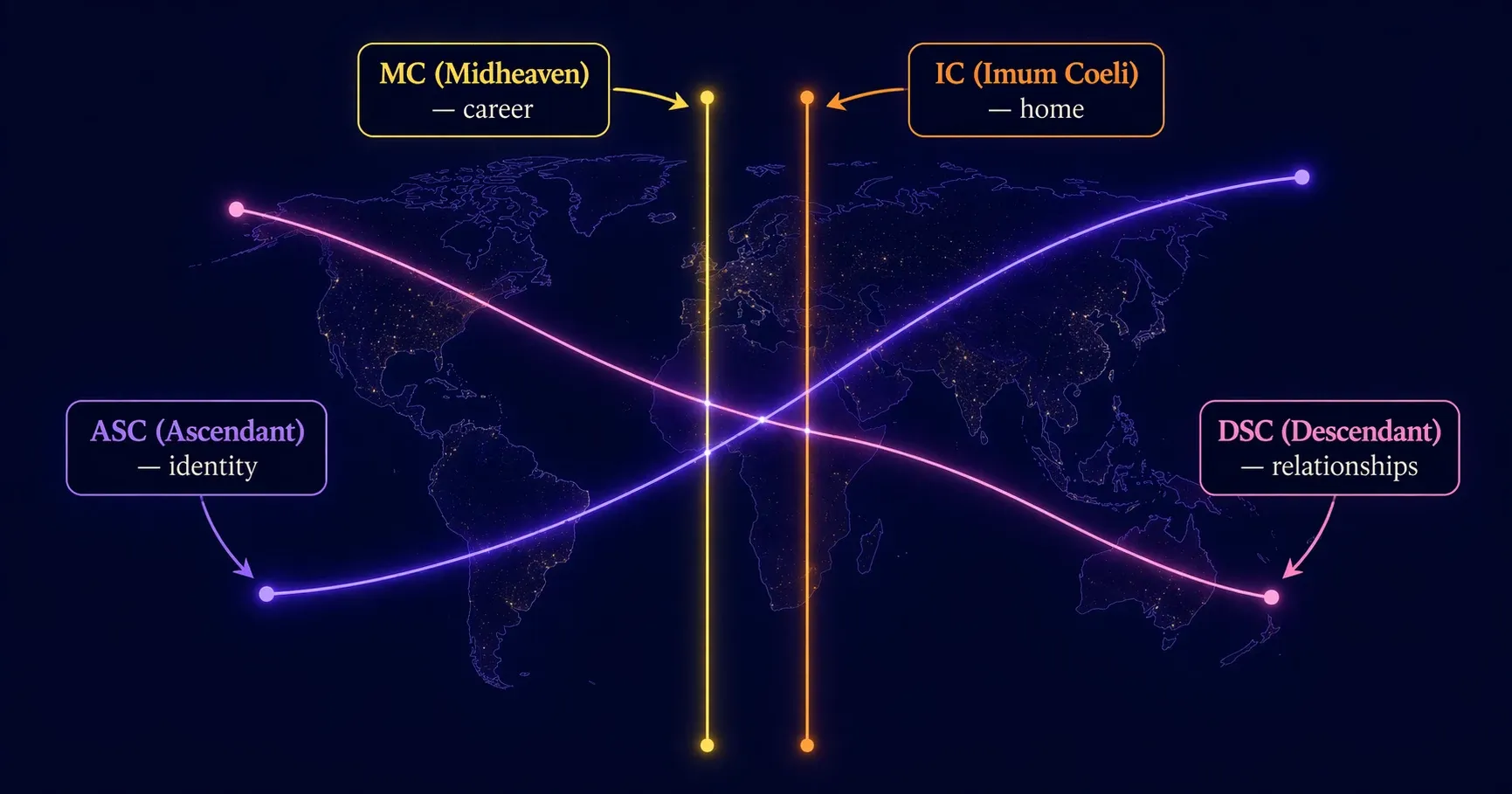
Every planet on your map has four lines, but you only need to learn what each line type means once. The four types tell you what life area gets affected:
| Line | Looks Like | What It Affects |
|---|---|---|
| MC (Midheaven) | Vertical line, top of map | Career, public reputation |
| IC (Imum Coeli) | Vertical line, bottom of map | Home, family, roots |
| ASC (Ascendant) | Curved line from East | Identity, body, first impressions |
| DSC (Descendant) | Curved line from West | Relationships, partnerships |
Visual identification tips:
- Vertical lines (MC, IC) always run straight north-south. Easy to spot.
- Curved lines (ASC, DSC) sweep across the map in big arcs. They look like flight paths because they basically are — they're great circles on a sphere flattened onto a rectangle.
You don't need to memorize which planet's MC vs IC is which line yet. Most calculators color-code them or label them on hover. Just learn to identify which of the four types you're looking at. More on what the ASC line specifically does when you want to go deeper.
Step 3: Triage by Proximity (Minute 3–5)
This is the step most articles skip and most readers desperately need. There are 44 lines on your map. You don't need to read 40 of them. Here's the rule:
Lines only matter if they're close to a place you care about.
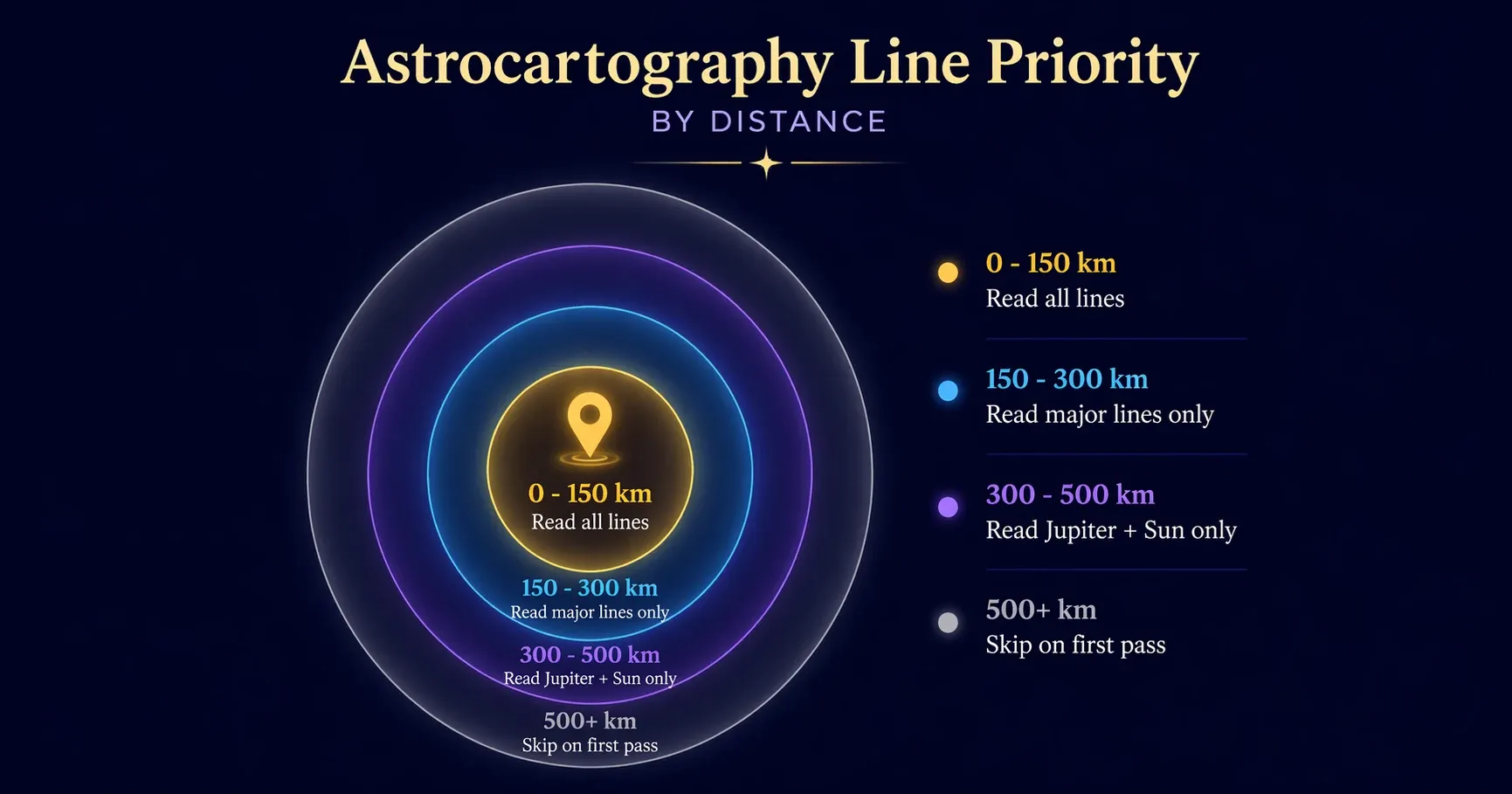
Pick the city you want to evaluate first (your current city, a city you're considering, or just somewhere meaningful). Then sort lines into four priority tiers:
| Distance from line | Priority | Action |
|---|---|---|
| 0–150 km | ⭐⭐⭐ Critical | Read every planet line in this band |
| 150–300 km | ⭐⭐ Important | Read major lines (Sun, Moon, Jupiter, Venus, Saturn) |
| 300–500 km | ⭐ Optional | Read only Jupiter and Sun lines |
| 500+ km | Skip | Ignore on first pass |
Most cities have 2–4 lines within the critical or important bands. That's manageable. Anything beyond 500 km is essentially inactive unless triggered by a slow-moving transit.
Two practical points:
- MC and IC lines run north-south, so you have a wider longitude window. A city that's 200 km east-west of an MC line still gets most of the effect.
- ASC and DSC lines are curved, so distance varies by latitude. The effect drops off faster.
Make a quick list of every line within 300 km of your target city. That's your reading list. Move to step 4.
Step 4: Decode Your 3 Closest Lines (Minute 5–8)
You now have a shortlist of lines within 300 km. Pick the closest 3 and look up what each one does using the cheat sheet below.
The formula is: Planet (energy type) × Angle (life area). So "Jupiter MC" means Jupiter energy (expansion, opportunity) on the MC angle (career, reputation) → career opportunities expand.
Planet Energies (Quick Reference)
Common Combinations
| Combination | Effect |
|---|---|
| Jupiter MC | Career growth, opportunities |
| Sun MC | Public visibility, recognition |
| Venus DSC | Love, romantic partnerships |
| Moon IC | Emotional home, family healing |
| Saturn MC | Lasting authority (slow build) |
| Mars ASC | Physical energy, drive |
| Pluto DSC | Transformative relationships |
| Neptune ASC | Dreamy presence, creativity |
For deep dives on specific combinations:
Step 5: Resolve Line Conflicts (Minute 8–9)
What happens when two lines cross the same city? Most articles dodge this question. Here's a clean decision rubric.
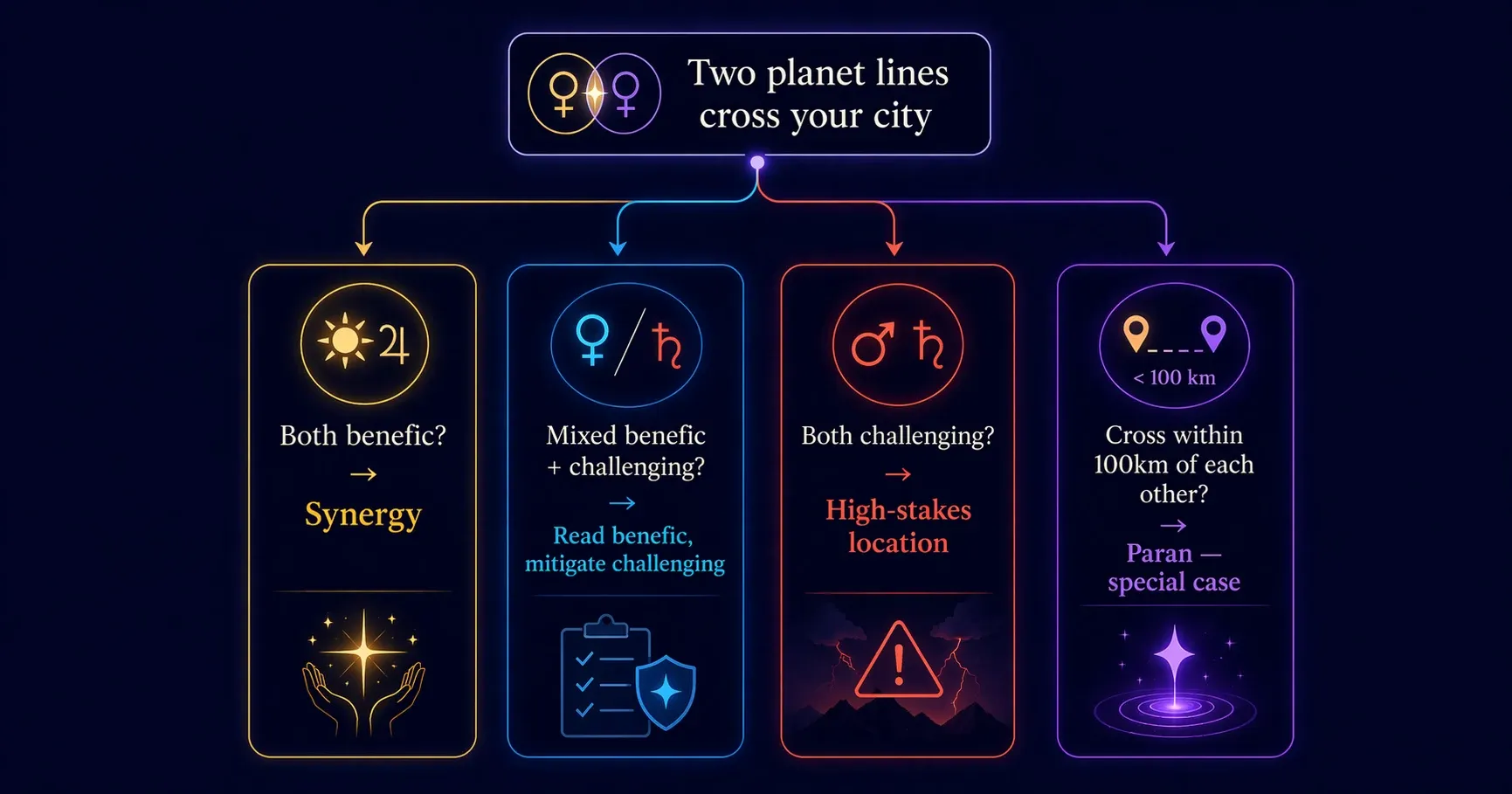
Case 1: Both lines benefic
(Venus, Jupiter, Sun.) Synergy. Both energies amplify each other. Venus + Jupiter = wealth + opportunity. Read both as positive; expect their combined themes to dominate.
Case 2: One benefic + one challenging
Read the benefic as your primary effect; the challenging line is context to manage. Example: Jupiter MC + Saturn ASC means career growth is real, but you'll feel more serious and isolated personally.
Case 3: Both challenging
(Saturn, Mars, Pluto.) High-stakes location. Big growth or big crisis depending on what you bring. Don't move here casually. Visit first.
Case 4: Cross within 100 km
This is a "paran" — a special interaction where the planets behave as if conjunct in your chart. Effects are amplified and the city becomes a hot spot. Our paran tool lists these automatically.
Step 6: Decide Your Next Move (Minute 9–10)
You now know what your closest 3 lines do and how to handle conflicts. You have one minute left. Pick one of four actions.
🌍 Visit
A benefic line passes through a city you've never been to? Plan a 1–2 week trip during a meaningful career or personal moment. Cheap experiment, real signal.
📦 Move
Jupiter MC, Sun MC, or Venus DSC through a city you'd actually want to live in? That's the strongest case. Don't move to a city you'd hate — the line won't fix that.
⏸️ Wait
Closest line is challenging (Saturn, Pluto) and you're not ready for that growth phase? Stay where you are. Lines don't expire. Come back to this map in 2 years.
🔄 Activate Remotely
Can't move? Line energy activates via 2–4 week visits during high-leverage career moments. Founders pitching for funding often do this with Jupiter MC cities.
That's the 10 minutes. You read your map.
What You Skipped (And When to Come Back)
This 10-minute reading is the first pass. It's enough for 80% of decisions. Here's what you can come back for later if you want to go deeper.
✓ First Pass (this guide, 10 minutes)
- Closest 3 lines decoded
- Conflicts resolved
- One next-move decision
⏱ Second Pass (30 minutes)
- Read all lines within 300 km of every city you care about
- Check parans (line crossings within 100 km)
- Compare 2–3 cities side by side
📚 Advanced (2+ hours)
- Cross-reference your natal chart — strong planets amplify their lines
- Check current transits to see which lines are activating now
- Consider the relocated chart for cities you're seriously considering
Most people stop at first pass. That's fine. The point of a map is to make a decision, not to study astrology.
For the systematic deep dive when you're ready, see our complete guide to reading your astrocartography map — it goes through every planet, every angle, and every paran in encyclopedic detail.
Worked Example: Sarah's Map in 10 Minutes
Sarah is a 27-year-old freelance designer born in New York. She's considering Berlin or Lisbon for the next chapter. Here's what her 10-minute reading looked like.
Step 1 (0:00–1:00)
Generated map with exact birth time (3:42 PM EST). All lines reliable.
Step 2 (1:00–3:00)
Identified four angular lines per planet. Standard map.
Step 3 (3:00–5:00) — Triage
For Berlin: Jupiter MC line passes 80 km away (critical). Venus IC line passes 250 km (important). For Lisbon: Sun ASC line passes 120 km (critical). Saturn MC passes 200 km (important).
Step 4 (5:00–8:00) — Decode
Berlin: Jupiter MC = career opportunities expand. Venus IC = beautiful, nurturing home life.
Lisbon: Sun ASC = visibility, confidence, personal magnetism. Saturn MC = slow but lasting career authority.
Step 5 (8:00–9:00) — Conflicts
Berlin's lines (Jupiter + Venus) are both benefic — synergy. Lisbon's lines (Sun + Saturn) are mixed — Sun's recognition will come, but Saturn will demand 5+ years of grind first.
Step 6 (9:00–10:00) — Decision
Sarah is in growth mode and wants opportunities, not a 5-year discipline phase. Berlin wins on the line analysis. She spent 2 weeks there to confirm fit, then signed a 1-year lease.
Total reading time: 9 minutes 40 seconds. Total decision: clear.
What If No Lines Pass Near Where You Want to Live?
This happens to about 1 in 5 people. Don't panic. You have three options.
Option 1: Move Within Range
Often there's a city 200–400 km from your dream city that has a strong line. Berlin instead of Munich. Austin instead of Houston. Check the wider region.
Option 2: Activate via Visit
2–4 week visits to cities on strong lines during meaningful career moments work. You don't need to relocate to benefit.
Option 3: Wait for Transits
When Jupiter or Saturn (slow-moving planets) transits your natal MC, your distant Jupiter MC line wakes up wherever you are. These windows happen every few years and create career bumps even with no relocation.
None of your locations are "wrong." Astrocartography is a tool for optimization, not a verdict on your life. If you love where you live and don't have strong lines through it, that's information — but it's not a problem to solve.
Frequently Asked Questions
Quick answers to the questions readers ask most. Click any question to expand.
How long does it take to read an astrocartography map?
The first-pass reading takes 10 minutes if you follow the 6-step process in this guide. Going deeper (comparing cities, checking parans, cross-referencing your natal chart) can take 30 minutes to 2+ hours depending on how systematic you want to be.
Do I need to know astrology to read my astrocartography map?
No. You need to know which planet means what (10 short definitions) and which angle means what (4 even shorter definitions). That's it. You don't need zodiac signs, houses, aspects, or any other astrology basics for first-pass map reading.
What if I don't know my exact birth time?
ASC and DSC lines need precise time (within 4 minutes). MC and IC lines are slightly more forgiving. Without an exact time, treat all lines as approximate — useful for direction-setting but not for committing to a city. Consider booking a chart rectification with a professional astrologer.
How do I read an astrocartography map on my phone?
Phones are tough — line clutter is hard to parse on small screens. Best practice: zoom into the region of one city at a time. Most calculators (including ours) support pinch-zoom. Don't try to read the global view on a phone — it's too dense.
What if no lines pass near where I want to live?
About 1 in 5 people face this. Three options: (1) check cities 200–400 km away in the same region, (2) use 2–4 week visits to activate lines remotely, (3) wait for transit windows when slow-moving planets activate distant lines. Detail in the "What If No Lines..." section above.
What if Venus and Saturn lines cross at the same city?
Read the benefic (Venus) as primary; treat the challenging line (Saturn) as context. The city offers love and beauty but also demands discipline and structure — possibly a serious, committed relationship that requires real work. See Step 5 above for the full conflict rubric.
How do I tell which lines are most important on my map?
Proximity to where you live or want to live. Lines within 150 km of your city are critical; lines 500+ km away are essentially inactive on first pass. See Step 3 for the full triage framework.
Do astrocartography effects work if I only visit, or do I need to move?
Both work. Living on a line gives you the full multi-year compound effect; visiting for 2–4 weeks during a meaningful moment gives you a partial, focused effect — enough for a single launch, pitch, or high-leverage event. Founders use short trips intentionally for funding rounds.
One Last Thing
The map is just data. The reading is what makes it useful.
Most people get lost in the lines because they treat the map as a study object instead of a tool for one decision. Don't do that. Read the closest 3 lines. Make one decision. Come back later if you want more.
If this guide saved you 3 hours of "learning astrocartography" — good. That was the goal.
Generate your map and try the 10-minute method.
Free. No registration. Swiss Ephemeris precision.
Put this into practice
Ready to Explore Your Astrocartography Map?
Generate your free personalized astrocartography map and discover your ideal locations for love, career, and personal growth.
Generate My Free Map