Vertex Calculator – Find Your Vertex Sign
The astrology Vertex calculator finds your Vertex sign, its exact degree and house — plus the Anti-Vertex opposite it.
Enter Your Birth Information
Provide your birth date, time and place to run the calculation
What Is the Vertex in Astrology?
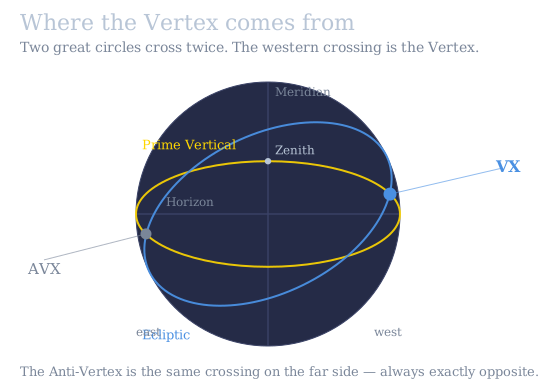
The Vertex is the point where the ecliptic crosses the prime vertical in the west. The prime vertical is the great circle running from due east, through the point directly overhead, to due west; the ecliptic is the path the Sun appears to trace through the year. Two great circles always cross twice, and the western of those two crossings is the Vertex. The eastern one is the Anti-Vertex, which is why the two are always exactly opposite each other.
It is not a planet and not a body of any kind. Like the Ascendant and the Midheaven it is a calculated angle, which means it exists only for a specific moment at a specific place on Earth. Astrologers usually read it as a point of encounter — the placement associated with meetings that arrive rather than meetings you arrange, and with turning points that feel decided from outside. Whether you take that literally or as a way of describing timing, the geometry underneath it is exact.
What a Vertex calculator does is resolve that geometry for your birth moment. The arithmetic needs the right ascension of your Midheaven, the obliquity of the ecliptic and your geographic latitude, none of which can be looked up from a date alone — which is why the Vertex is missing from most free chart readouts even when the rest of the chart is there.
How the Vertex Calculator Works
The Vertex calculator turns your birth date, time and city into one exact instant, computes the local sidereal time for that instant, and solves for the point where the prime vertical meets the ecliptic on the western side. It then places that longitude in a sign, reports the degree, and works out which house it falls in from your chart’s own cusps. The Anti-Vertex is the same longitude plus 180°, so the Vertex calculator returns both ends of the axis rather than making you derive the second one.
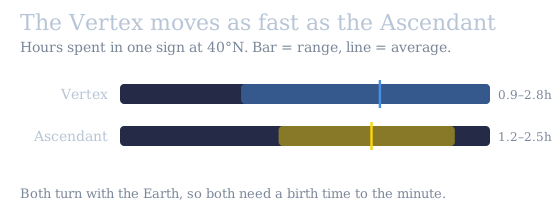
Because the prime vertical is defined by your horizon, the answer depends on latitude as much as on time. Two people born in the same minute in Lisbon and in Tokyo have different Vertex signs. And because the Earth turns, the Vertex moves as quickly as the Ascendant does — it holds a sign for a couple of hours at most. A birth time rounded to the nearest hour is often enough for a Sun sign and is not enough here.
Why the Vertex Only Falls in Six Houses
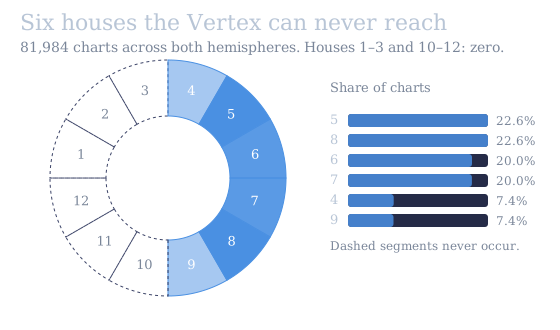
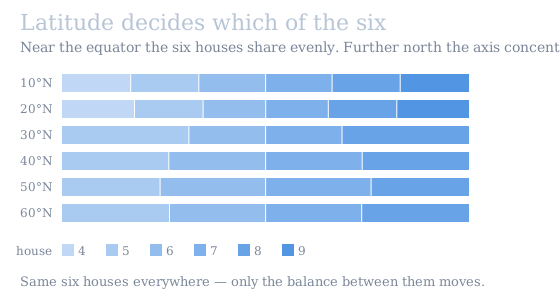
Here is something no chart readout tells you: the Vertex can only ever occupy houses four through nine. Six of the twelve are geometrically unreachable. Measured across 81,984 charts spanning both hemispheres and every hour of the day, houses one, two, three, ten, eleven and twelve came up exactly zero times.
The reason is definitional. The Vertex is the western crossing, so it always lands on the western half of the chart, and the western half is houses four through nine. If you have seen a reading that places a Vertex in the eleventh house, the software used a different convention or made an error. A Vertex calculator that reports a house outside four to nine is telling you something is wrong with the input rather than something unusual about the chart.
Vertex vs Descendant: The “Third Angle” Myth
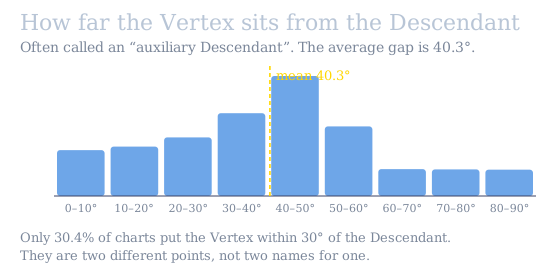
Astrology texts often call the Vertex an auxiliary Descendant, or the chart’s third angle, which implies the two points sit close together. They do not. Over the same 81,984 charts the Vertex averages 40.3° from the Descendant — more than a whole sign apart, on average.
Only 30.4% of charts put the Vertex within 30° of the Descendant, and the gap runs as wide as 90°. They share a hemisphere and a theme, and that is where the resemblance ends. Treating them as interchangeable is the single most common mistake in Vertex readings, and it is why this Vertex calculator prints the actual distance next to your result instead of leaving you to assume.
The Vertex in Synastry
The Vertex earns most of its reputation in comparison charts rather than in solo ones. When another person’s Sun, Moon, Venus or Ascendant lands on your Vertex within a few degrees, astrologers read it as one of the strongest markers of a relationship that arrives unbidden and changes direction. The Anti-Vertex works the same way from the opposite side.
That is also why the exact degree matters more here than the sign does. A contact three degrees off is a different reading from one that is exact, and a birth time that is half an hour out can move the point far enough to erase the aspect entirely. Run the Vertex calculator for both charts, note both degrees, and compare those rather than comparing sign names.
How to Use This Vertex Calculator
- Enter your birth date, the time as precisely as you know it, and your birth city. The Vertex calculator needs the city rather than just a country, because latitude changes the answer.
- Read the axis. The Vertex sits on the left, the Anti-Vertex opposite it, and both carry a sign, an exact degree and a house.
- Check the distance from your Descendant printed underneath before reading the Vertex as a second Descendant — for most charts it is nowhere near.
The Vertex Through the 12 Signs
A Vertex in Aries brings the fated meeting through initiative — someone arrives while you are already moving, and the encounter starts at speed. These are the connections that begin with a decision rather than a drift.
A Vertex in Taurus tends to bring people in through the ordinary and the physical: shared work, shared meals, a place. The turn is slow and it holds. Nothing about it feels dramatic until you look back.
A Vertex in Gemini brings the encounter through words — a conversation, a message, an introduction that was not planned. The meeting often happens sideways, through a third person or a passing exchange.
A Vertex in Cancer draws people in through home, family and care. The fated contact tends to arrive when you are at your least guarded, and it reshapes what belonging means rather than what you do.
A Vertex in Leo brings the meeting through visibility. You are seen doing something, and that is the hinge. These connections often begin in public and carry an element of performance neither person planned.
A Vertex in Virgo works through usefulness — being needed, solving something, showing up on a task. The encounter rarely announces itself; it accumulates until you notice it has changed the shape of your days.
A Vertex in Libra is the most literal of the twelve: the fated contact arrives as a partnership. Meetings feel mutual from the first minute, and the pull is toward balance rather than toward intensity.
A Vertex in Scorpio brings encounters that go deep immediately and rarely stay casual. Something is exposed early. These are the connections people describe as recognising someone they have never met.
A Vertex in Sagittarius brings people in through distance, travel, study or belief. The meeting often happens away from home, or with someone whose world does not overlap yours until it suddenly does.
A Vertex in Capricorn works through structure and time — an institution, a role, a long project. The contact is made in a formal setting and becomes personal much later than either party expects.
A Vertex in Aquarius brings the encounter through groups, causes and networks. It is the placement most likely to describe meeting through a community rather than through any one person.
A Vertex in Pisces brings the meeting through something dissolved: a shared feeling, an art form, a hospital, a period of drift. The circumstances are usually hard to reconstruct afterwards.
The Six Houses the Vertex Can Occupy
Vertex in the fourth house places the turning point at home, in family, and in what you treat as your base. Encounters that matter arrive through a household, a hometown or a private life rather than through work or a public stage.
The most common placement. Vertex in the fifth house puts the fated meeting in the territory of romance, play, and creative work. It is the house of what you do for its own sake, and the encounter tends to arrive there rather than through obligation.
Vertex in the sixth house locates it in daily work, routine and service. This is the colleague who becomes something else, the meeting that happens because you were both simply there every day for months.
Vertex in the seventh house — the placement people expect, though it is only one of six. Here the Vertex sits in the house of partnership itself, and the fated encounter arrives as an explicit one-to-one bond.
Tied for the most common. Vertex in the eighth house puts the turn in shared resources, intimacy and things that cannot be undone. Encounters here change the terms of your life rather than adding to it.
Vertex in the ninth house places it in travel, study and belief. The meeting arrives from outside your ordinary world — abroad, in a course, or through a conviction you did not hold a year earlier.