Moon Sign Meditation: How to Write a Guided Script and Voice It With AI
Generic moon meditations rarely land. Here is how to write a guided meditation around your own Moon sign — five-part script, breathing by element, 12 Moon-sign images — and turn it into audio you can play tonight.
Written by AstroChart Team
Most moon meditations online are written for everyone at once: the same full moon, the same breathing, the same invitation to “release what no longer serves you.” They are pleasant, and they rarely land, because the thing that actually calms you down is personal — and in astrology, it has a name. It is your Moon sign.
This guide shows you how to write a guided meditation built around your own Moon: a five-part script, a breathing pattern for your element, an image and a closing line for each of the twelve Moon signs, and separate versions for the New Moon and the Full Moon. Then it covers the step most people skip — turning the script into audio, so you can listen with your eyes closed instead of reading your own instructions off a screen.
Why Start With Your Moon Sign
Your Sun sign describes what drives you. Your Moon sign describes what you need to feel safe — how you settle, what soothes you, what a good night actually looks like. That makes it the right raw material for a meditation, whose whole job is to help you settle.
The differences are practical, not decorative. An Aries Moon tends to calm down by moving first and stopping second; ask it to sit perfectly still in minute one and it will fidget. A Virgo Moon relaxes when it knows what comes next, so a clear sequence matters more than the scenery. A Pisces Moon may find counted breathing jarring and drift off happily to a description of warm water.
If you don’t know your Moon sign yet, the Moon sign calculator finds it from your birth date; your birth time only matters if the Moon changed sign on the day you were born.
The Five-Part Script
Every good guided meditation follows roughly the same arc: arrive, slow down, go deep, then come back. Give each part a set share of the time and the script almost writes itself.
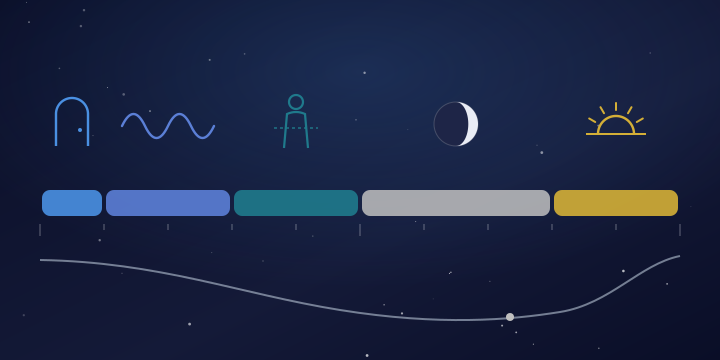
- Arrival (about 1 minute). Permission to stop. Settle the posture, notice the room, let the day end.
- Breath (about 2 minutes). One breathing pattern, matched to your element — more on that below.
- Body (about 2 minutes). Move attention through the body. Earth and water Moons usually like to start at the feet; fire and air Moons often settle faster starting at the head and moving down, out of the busy mind.
- The Moon image (about 3 minutes). One image from the table further down, built slowly with sound, temperature and texture. This is where the longest pauses go.
- Return (about 2 minutes). Your closing line, three slower breaths, the sounds of the room, and an invitation to open the eyes.
A calm meditation voice runs well below conversational speed, and the silences take up a large share of the track, so a ten-minute meditation usually needs only 550 to 750 words. If your draft is much longer, it is too busy.
Breathe the Way Your Element Settles
The breathing section works best when it suits the way your Moon’s element calms down.
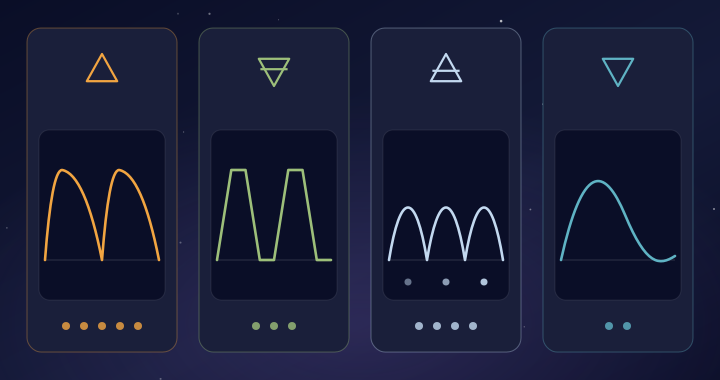
- Fire Moon (Aries, Leo, Sagittarius) — let the exhale run longer than the inhale: in for four, out for six. Fire Moons tend to arrive wound up, and the long exhale brings the heat down without demanding stillness straight away.
- Earth Moon (Taurus, Virgo, Capricorn) — box breathing: in for four, hold for four, out for four, hold for four. The predictability is itself soothing.
- Air Moon (Gemini, Libra, Aquarius) — count each breath from one to ten, then start again. It gives the mind a small job so it stops looking for a bigger one.
- Water Moon (Cancer, Scorpio, Pisces) — no counting at all. Describe the breath as a wave rising and falling at its own pace; numbers tend to feel like an interruption.
Keep every pattern gentle. If holding the breath or counting feels uncomfortable, the script should say so out loud: breathe normally, and the meditation still works.
Images and Closing Lines for All 12 Moon Signs
The heart of the script is a single image, described slowly enough to step into. Pick the row for your Moon sign, build the image with two or three senses, and end the meditation with the closing line — or a version of it in your own words.
| Moon sign | What soothes it | The image | Closing line |
|---|---|---|---|
| Aries | movement first, then stillness; short, clear instructions | a campfire burning down to warm embers | “I don’t have to win anything tonight.” |
| Taurus | warmth, touch, slowness, physical comfort | lying on warm earth in a garden after rain | “I am safe, and there is enough.” |
| Gemini | naming things, light curiosity, counting | watching thoughts cross a wide sky like birds | “The questions can wait until morning.” |
| Cancer | feeling held, home, the familiar | moonlight on a quiet harbour, a lit window waiting | “I am held, and I can rest.” |
| Leo | warmth, being seen kindly, the heart | the last golden light of a long summer evening | “I am enough without an audience.” |
| Virgo | order, a clear sequence, checking in with the body part by part | a tidy room, an open window, folded linen | “What I did today was enough.” |
| Libra | balance, beauty, gentle harmony | a still lake holding a perfect reflection of the Moon | “I can choose peace for myself first.” |
| Scorpio | depth, privacy, permission to feel things fully | sinking slowly through calm, dark water | “I can let this go without losing myself.” |
| Sagittarius | space, freedom, a sense of meaning | an open night sky over a wide plain | “There is room for everything I feel.” |
| Capricorn | structure, a job finished, permission to stop | a mountain at dusk, the climb done for today | “I am allowed to put the weight down.” |
| Aquarius | perspective, a little distance, fresh air | the Earth seen from far above, quiet and small | “I belong, even when I feel apart.” |
| Pisces | softness, music, water, dissolving edges | floating on a warm, starlit sea | “I can rest where the edges blur.” |
One image per meditation is plenty. A listener who is asked to picture a beach, then a forest, then a starfield spends the whole track changing scenery instead of resting.
New Moon or Full Moon?
The same Moon sign can carry two very different meditations, depending on where the Moon is in its cycle.
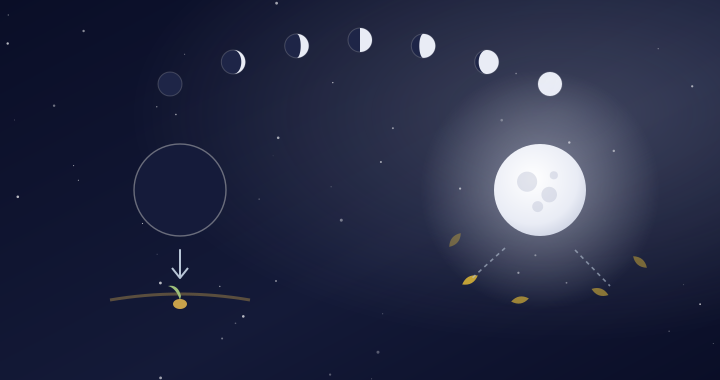
- New Moon — the Sun and the Moon together, the night sky dark. Write a quieter, more inward script and end it with one intention, said in a single sentence. Planting, not planning.
- Full Moon — the Moon opposite the Sun and fully lit. Write a script about release: name one thing to set down, let your Moon image carry it away, and end with something you are grateful for.
A useful rule: build the core of the script — breathing, image, closing line — from your natal Moon, and take only the theme from tonight’s phase. If you want to know which phase you were born under, the moon phase calculator shows it, along with the sign your Moon was in.
Worked Example: A Full Moon Script for a Cancer Moon
Here is how the pieces combine for someone with the Moon in Cancer — a water Moon, so wave breathing and no counting, and the harbour image from the table. These are excerpts from the arrival, the image and the return; the breath and body sections follow the patterns above.
Picture a small harbour at night. The water is calm, and moonlight lies across it in one long silver path. (pause) Somewhere behind you, in a house you know, a single window is lit. Someone has left it on for you. (long pause) Think of one thing you have been carrying this month. You don’t need to solve it. Just set it down on the water, and watch the tide take it, slowly, out along the path of light. (long pause)
I am held, and I can rest. (pause) Take three slower breaths. (pause) Notice the sounds of the room around you, and when you are ready, open your eyes.
Notice what the script does not do: it doesn’t explain astrology, it doesn’t list everything a Full Moon can mean, and it never asks the listener to do two things at once. Every sentence is short enough to say on one breath.
Turn the Script Into Audio With an AI Voice
You cannot meditate and read at the same time, and many people find recording their own voice awkward. An AI voice solves both: you paste the script into an AI voice generator such as AnyVoice, choose a calm voice, and get a track you can play every night — then regenerate it in a minute whenever you change a line.
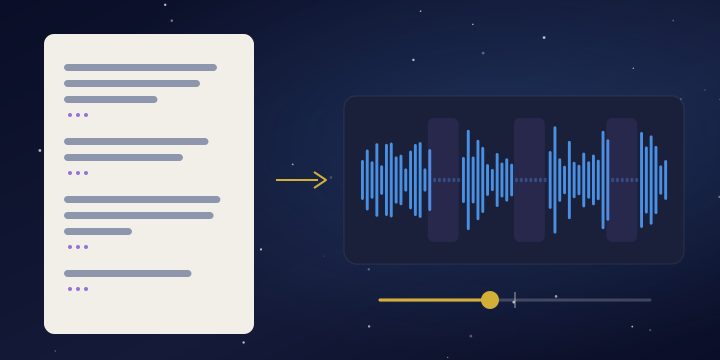
A few habits make the result sound like a meditation rather than an announcement:
- Write the pauses in. Most voices read straight through anything that looks like ordinary prose. Short paragraphs, line breaks and full stops all create space; if your tool supports pause or break markers, use them for the long silences inside the Moon image.
- Slow it down slightly. If there is a speed setting, try a little below normal before you touch anything else.
- Write numbers as words. “In for four” reads more naturally than “in for 4”.
- Test the first minute first. Generate the arrival alone, listen with your eyes closed, adjust, and only then produce the whole track.
Then match the voice to your Moon’s element:
- Fire Moon: warm and steady rather than sleepy; shorter pauses early, longer ones toward the end.
- Earth Moon: a lower, even voice at the slowest pace, with pauses that fall at regular intervals.
- Air Moon: a clear, light voice at a moderate pace, with a pause after every image.
- Water Moon: the softest voice you can find, the longest pauses, and a track that ends in silence rather than a final word.
Five Mistakes That Keep a Meditation From Working
1. Writing for the page instead of the ear
Long sentences with commas and clauses read well and sound breathless. If you can’t say it on one exhale, split it.
2. Leaving no silence
A meditation is mostly pauses. A track with no gaps is a lecture, however gentle the voice.
3. Stacking images
One place, explored slowly, beats five places visited in passing.
4. Ending abruptly
Always bring the listener back: the closing line, a few breaths, the room. Skipping the return is why some meditations leave people groggy rather than rested.
5. Writing from your Sun sign
The Sun describes your drive, not your comfort. A Leo Sun with a Capricorn Moon will relax far more to a finished climb than to a spotlight.
Frequently Asked Questions
Do I need my birth time to find my Moon sign?
Usually not. The Moon stays in each sign for about two and a half days, so your birth date is enough unless the Moon changed sign on the day you were born — in that case your birth time decides which of the two signs is yours.
How long should a moon meditation be?
Ten minutes is a good place to start, and the five-part structure scales easily: halve every section for a five-minute version before sleep, or stretch the Moon image for a longer session on the night of a Full Moon.
Should I use my natal Moon sign or the sign the Moon is in tonight?
Use your natal Moon for the core of the script — the breathing, the image and the closing line — and let tonight’s phase set the theme: intention at the New Moon, release at the Full Moon.
Can I share or publish the audio?
The script is yours. Whether you can publish the voice track depends on the licence terms of the voice tool you used, so check them before you post it anywhere public.
Can a moon meditation help with anxiety?
Many people find a short, predictable evening routine calming, and a meditation written around your own needs is easier to keep up. It is not a treatment, though — if anxiety is persistent or getting worse, talk to a doctor or a mental health professional.
Record Your Own
The whole method fits on one page: five sections, one breathing pattern for your element, one image for your Moon sign, one closing line, and plenty of silence. Write it once, voice it, and listen to it for a whole lunar cycle before you change anything.
Start with your Moon sign
The Moon sign calculator gives you your Moon sign in one step. Write the script from the table above, then paste it into AnyVoice to turn it into a track you can play tonight.
And if you would like a reason to write a fresh script each month, the lunar return calculator shows when the Moon comes back to the position it held at your birth — a natural moment to start over.
Put this into practice
Ready to Explore Your Astrocartography Map?
Generate your free personalized astrocartography map and discover your ideal locations for love, career, and personal growth.
Generate My Free Map