Written by the AstroChart team · Last updated September 18, 2026
01What a tarot reading is, and what this one adds
A tarot reading draws cards from a 78-card deck and reads each one in a position that frames a question. The cards are a structure for reflection, not a forecast.
A tarot reading works by giving your thinking a shape. You bring a question, the cards bring images and ideas, and the positions in the spread tell you how to relate one to the other: this card is what has shaped the situation, this one is where it stands, this one is what is forming. A good tarot reading does not tell you what will happen. It gives you three angles on your question that you might not have taken yourself, and the space to notice which one lands.
This free tarot reading does one thing no other online tarot reading does. Every card in the Rider-Waite-Smith deck was designed around an astrological correspondence: The Tower is Mars, The Lovers is Gemini, the Five of Pentacles is Mercury in Taurus. So after the cards are read, we look up the planet each one points to in your own birth chart, today, and show you what it is doing. A card is a general idea. The planet behind it, in your chart right now, is a specific fact about you.
The cards themselves are always free and unlimited, so you can do a tarot reading as often as you like. The chart layer needs your birth details, and is free once for a visitor and once a week with a free account.
02The 78 cards: Major Arcana, Minor Arcana and their astrology
How many cards are in a tarot deck? Seventy-eight, in two groups. The Major Arcana are 22 named cards, from The Fool to The World, that deal with large themes and turning points; when several appear in one tarot reading, the question is bigger than it looks. The Minor Arcana are 56 cards in four suits of fourteen: an Ace, the numbers two to ten, and four court cards (Page, Knight, Queen, King). They deal with day-to-day life, and they are where most of a tarot card reading usually comes from.
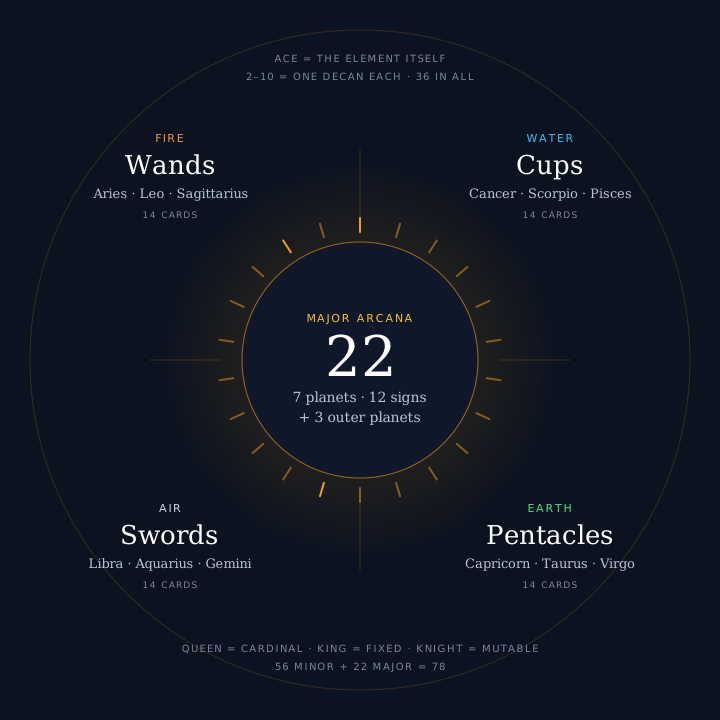
Each suit belongs to an element. Wands are fire: drive, creativity and will. Cups are water: feeling and relationship. Swords are air: thought, speech and conflict. Pentacles are earth: work, money, the body and practical life. A reading dominated by one suit is telling you which part of life the question really lives in. In a tarot reading that mixes suits, notice which element is missing as well as which is present.
The astrology comes from the Hermetic Order of the Golden Dawn, whose members, including Arthur Edward Waite and the artist Pamela Colman Smith, designed the deck in 1909. Their system gave every card an astrological address. The majors are planets and signs. The number cards two to ten are the 36 decans, the ten-degree slices of the zodiac, each with a ruling planet. The court cards are the cardinal, fixed and mutable signs of their element. It is this map, over a century old, that lets a tarot reading on this page look at your chart without inventing anything.
A few of the correspondences
| Card | Astrology | Planet read in your chart |
|---|---|---|
| The Magician | Mercury | Mercury |
| The Lovers | Gemini | Mercury (Gemini’s ruler) |
| The Tower | Mars | Mars |
| The Star | Aquarius | Uranus (Aquarius’s ruler) |
| Five of Pentacles | Mercury in Taurus | Mercury |
| Ten of Swords | Sun in Gemini | Sun |
| Queen of Cups | Cancer | Moon (Cancer’s ruler) |
| Ace of Wands | The element of fire | How much of your chart is in fire |
03How this tarot reading reads your cards against your chart
Every tarot reading here has three layers, and each one is labelled on the page so you always know which part of the tarot reading you are looking at.
- 01
The cards
Each card is read in its position, upright or reversed, from a library written for this site. Then a short paragraph on the pattern the three make: how many Major Arcana, whether one element dominates, whether numbers repeat. This layer is deterministic, free and unlimited.
- 02
What they touch in your chart
Each card points at a planet. We calculate today’s sky against your birth chart and report the tightest aspect that planet is making, with how close it is to exact. If the planet is making no aspect, the card says it is quiet today. Aces and Pages point at an element rather than a planet, so they report how much of your chart is in that element. If two cards point at the same planet, you see it once, with both names on it.
- 03
Reading them together
Finally, one short paragraph says how the cards and the chart fit. It is written from the two layers above and nothing else, and it is checked: a sentence naming a planet or a figure that is not in those layers is removed before you see it.
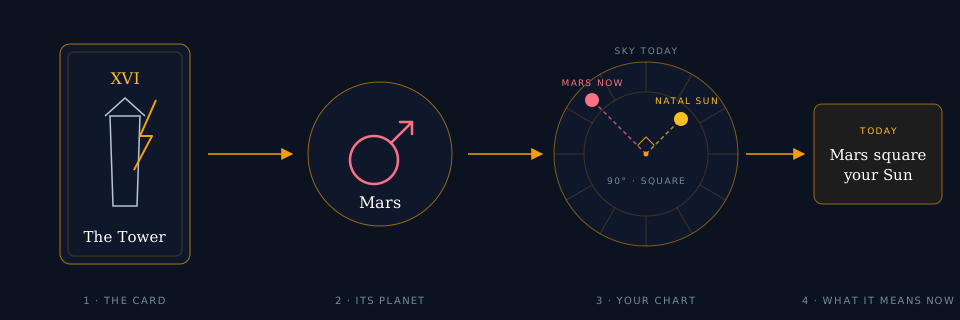
An example tarot reading. You draw The Tower in the present position. The Tower is Mars. Today, transiting Mars is opposing your natal Saturn, exact within a day. The card says something built on a weak foundation is giving way; your chart says the pressure is on your long-term commitments, and it is at its peak now. Neither says what to do. Together, they tell you where to look.
04How to do a tarot card reading: positions, reversals and patterns
Anyone can learn how to read tarot cards, and the fastest way to learn how to do a tarot reading is to learn three things at once: what the positions mean, what a reversal changes, and what the whole spread is saying beyond its individual cards.
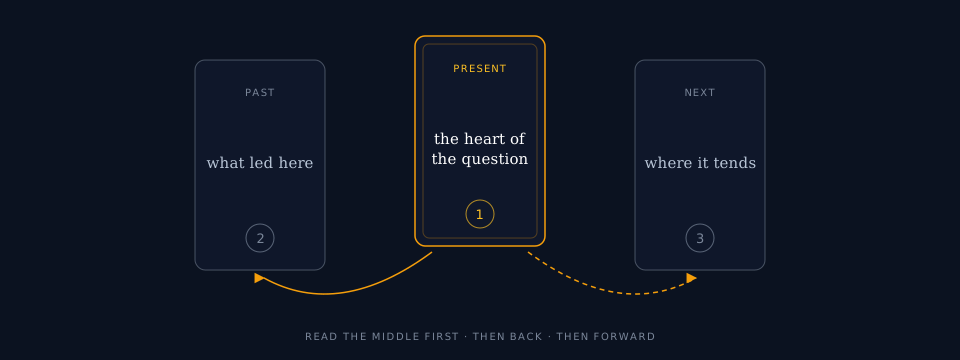
Positions
This page uses the three-card spread: past, present and next. The past card is what has shaped the question, often something you already know but have not connected to it. The present card is where things stand, and it is usually the card to act on. The next card is not a prediction but a direction: what is forming if nothing changes. When you do a tarot reading of your own, read the middle card first; in a three-card tarot reading it carries the most weight.
Reversals
About one card in three comes out reversed. There are two traditions for reading them: as the opposite of the upright meaning, or as the same energy blocked, delayed or turned inward. Every tarot reading on this page uses the second, consistently. A reversed Sun is not misery; it is joy that has not quite been let in.
Patterns
Before you read card by card, look at the three together. Two or three Major Arcana mean the question touches something large. Two cards from one suit tell you which area of life it lives in. Repeated numbers repeat a theme. Mostly reversed cards say the reading is about what is blocked. A good tarot card reading starts with the whole and then narrows.
The one skill that matters most in any tarot reading is honesty with yourself. The card that makes you flinch is usually the one to read twice.
05Choosing a question a tarot reading can answer
The best questions for a tarot reading are open and about you. “What do I need to understand about this relationship?” gives three cards something to work with. “Will he come back?” does not, because it asks the cards to decide something that belongs to another person, and because a yes or no closes the reflection the cards are good at.
If you have a yes-or-no question, turn it into “What should I know before I decide?” If you have no question at all, choose General; a general tarot reading will show you what is already on your mind.
06Tarot and astrology: two languages for the same questions
Tarot and astrology grew up in the same place. The images on the cards draw on the planetary and zodiacal symbolism of the Renaissance, and by the time the Golden Dawn systematised the deck in the late nineteenth century the correspondences were already old. Reading a card against a chart is not mixing two traditions; it is reading one tradition in both of its forms.
What we do with that is narrow and specific. We do not claim the cards know your chart, or that your chart chose the cards. In each tarot reading we draw at random, read the cards on their own terms, and then show you, as a separate and clearly labelled layer, what the planets they point to are doing in your chart today. You decide how much the two have to say to each other.
07Frequently asked questions
Is this tarot reading free?
Yes. The cards, their meanings and the pattern of the spread are free and unlimited, with no sign-up. The chart layer is free once as a visitor and once a week with a free account; Pro reads every draw against your chart and keeps your readings.
How many cards are in a tarot deck?
Seventy-eight: 22 Major Arcana and 56 Minor Arcana in four suits of fourteen. This free online tarot reading uses the full deck, and every card can come up upright or reversed.
How are the cards shuffled online — is it really random?
The deck is shuffled in your browser with cryptographic randomness before every draw, and nine cards are laid out face down. The three you click are your cards; nothing is chosen for you and nothing is decided in advance. About one card in three comes out reversed.
What does a reversed card mean?
In this tarot reading, a reversed card is the same energy blocked, delayed or turned inward, not its opposite. It points at what is being held back rather than at a bad outcome, which keeps a tarot reading from reading as a verdict.
Can a tarot reading predict the future?
No, and no tarot reading on this page is used that way. The next position describes what is forming if nothing changes, which is a direction to think about, not an event that will happen.
Are tarot cards evil?
Tarot began as a card game in fifteenth-century Italy and was only given occult meanings in the eighteenth century. It is a set of symbols; what it becomes depends on how it is used. Here it is used as a structure for reflection.
Why read tarot against a birth chart?
Every card in this deck has an astrological correspondence set down by the Golden Dawn in the 1880s. Looking up the card’s planet in your chart today turns a general meaning into a specific fact about your situation, which you can check in your birth chart yourself. It is what makes this a personal tarot reading rather than a general one.
Where do my tarot readings go?
If you are signed in, each tarot reading is saved to My Readings with the cards, the chart links and the combined reading, so you can come back to it. Free accounts keep the last seven days; Pro keeps everything.
08Keep going
Ask My Chart
Put the question from your reading to your chart directly.
Today's Reading
The strongest transit to your chart today, hour by hour.
All Readings
Every way this site reads your chart, in one place.
Transit Chart
The full sky against your natal chart, with exact dates.
Birth Chart
Every placement a card can point to, in full.
Card images: the Rider-Waite-Smith tarot, original 1909 edition, drawn by Pamela Colman Smith. Public domain; scans from Wikimedia Commons.