Written by the AstroChart team · Last updated September 18, 2026
01Why AI astrology from your own chart beats a sun-sign horoscope
An AI astrologer answers a specific question by reading your natal chart and the current transits to it, not your zodiac sign.
A sun-sign horoscope is written for one twelfth of everyone alive. It has to be, because the only thing it knows about you is the month you were born. Your birth chart knows a great deal more: ten planets in twelve signs and twelve houses, the angles that fix the chart to the place and minute of your birth, and the aspects between all of them. Two people born the same day can have Venus in different houses and a different planet ruling their seventh, and their love lives read nothing alike. That is the first thing AI astrology has to get right, and most of it does not try.
AI astrology is only as good as what it reads. Most AI astrologer tools take your birth date and then answer from the same broad strokes a horoscope column uses, because the model was never handed your actual placements. Ask My Chart works the other way round. The chart is calculated first, with the same astronomy-engine precision the rest of AstroChart runs on, and the model is only allowed to arrange what that calculation produced.
That is the difference this AI astrology page is built on. When you ask an AI astrologer here why work has felt heavy, the answer names the transit that is pressing on your Midheaven and the natal Saturn it is pressing on. You can check both in your birth chart. A horoscope cannot be checked at all.
02What you can ask, and what this AI astrologer won't do
The AI astrologer answers six kinds of question, each read from a different part of the chart. Anything outside them is declined rather than improvised. Good AI astrology is defined as much by what it declines as by what it answers.
Love and relationships
How you love, what you need, why a relationship feels the way it does right now. Read from Venus, the Moon, Mars, your fifth and seventh houses and the ruler of the seventh.
Career and direction
Your working style, what environments suit you, whether this is a period for a move. Read from the Sun, Saturn, Jupiter, the Midheaven, your tenth, sixth and second houses.
Money
How you tend to earn, hold and spend, and what is active in your finances now. Read from the second and eighth houses, Venus, Jupiter and Saturn.
Today and this week
The strongest transit to your chart right now, how close it is to exact, and whether a coming window suits a decision.
Your placements
Where a planet sits in your chart, in which sign and house. A lookup, answered instantly and never counted against your questions.
Places
Whether a city suits you, or how two cities compare for love or career. Read from your astrocartography lines and your relocated chart for that place. No other AI astrology tool does this.
What this AI astrologer won't do
- Name a date on which something will happen. It will tell you when an influence is strongest and when it eases, and leave what you do with that to you.
- Give medical, legal or financial advice. Those sentences are filtered out before you see them.
- Read a chart for someone who has not agreed to it. Compatibility questions belong in the synastry calculator, where both people's details are entered deliberately.
- Answer from its own ideas about astrology. If your chart holds nothing specific on a question, it says so.
03How the AI astrology answer is built: from your question to the placements behind it
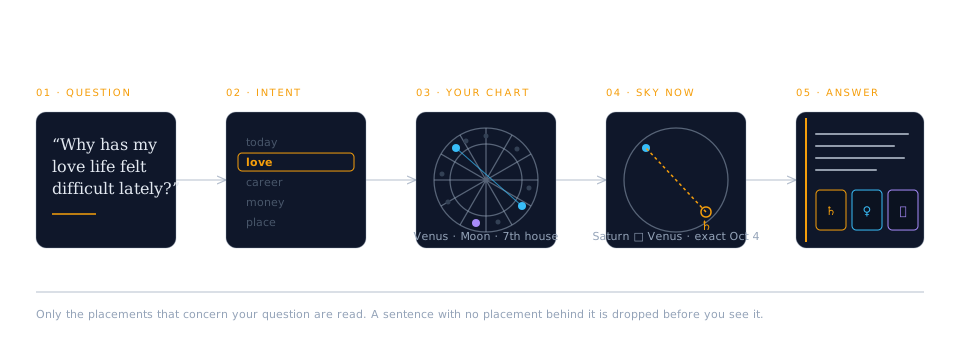
Every AI astrology answer here goes through the same five steps. Knowing them is what lets you judge whether to trust one.
- 01
Your question is sorted into one area
Love, career, money, today, a placement, or a place. The chips on the page already carry their area; a typed question is classified once, cheaply, and nothing else about it is kept.
- 02
Only the relevant placements are read
A love question does not read your tenth house, and a career question does not read your Venus aspects. The table below is the whole rule. Fewer facts make a clearer answer and give the model less to garble.
- 03
The sky right now is laid over them
Transits are calculated for today against your natal chart and kept only where they touch the placements from step two. Each carries its orb and the date it is exact.
- 04
Pre-written sentences are arranged
Every placement and every transit already has an interpretation in AstroChart's library, reviewed and translated into eight languages. The model receives those sentences and arranges them into an answer to your question. It does not write astrology, and that is what separates grounded AI astrology from a chatbot with a horoscope prompt.
- 05
The answer is checked against its sources
A sentence that names a planet, a house or a figure not present in the facts is removed. If the model's whole answer fails, you receive the library sentences in plain order instead. There is no state in which you receive invented astrology.
Which placements each area reads
| Area | Natal placements | Transits kept |
|---|---|---|
| Love | Venus, Moon, Mars · 5th and 7th houses · ruler of the 7th | Aspects to Venus, Moon, Mars and the 7th ruler |
| Career | Sun, Saturn, Jupiter · Midheaven · 10th, 6th, 2nd houses · ruler of the 10th | Aspects to Sun, Saturn, Jupiter and the 10th ruler |
| Money | Venus, Jupiter, Saturn · 2nd and 8th houses · ruler of the 2nd | Aspects to Venus, Jupiter, Saturn and the 2nd ruler |
| Today | The chart as a whole | The three tightest aspects today, ranked by orb |
04Reading the evidence cards
Under every AI astrology answer sits a row of cards. Each one is a single fact the answer was built from, and each is one of three kinds. A natal card names a planet, its sign and its house in your birth chart: this is you, and it does not change. A transit card names a moving planet, the aspect it is making and the natal point it is making it to, with the orb and the date it is exact: this is the weather, and it will pass. A progressed card, where one appears, names where your progressed Moon has moved to: this is the season you are in, and it changes over months rather than days.
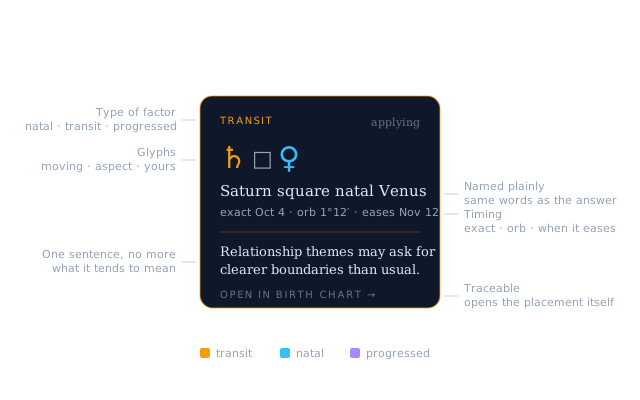
The orb is how far from exact the aspect is, in degrees. Under one degree is as sharp as a transit gets; past five it is fading in or out. The exact date tells you which side of the peak you are on. An aspect that is exact in twenty days is building; one that was exact last week is releasing. The answer will usually say which, but the card lets you see it for yourself.
Hover a card and the sentences it supports light up in the answer. If a sentence lights nothing, the checker let something through it should not have, and the thumbs-down under the answer is how you tell us. Every card also opens the placement in your full birth chart, so a reading can lead you into the chart itself rather than away from it.
05Ask about places, not just people
AstroChart began as an astrocartography calculator, and the AI astrologer inherits that. Ask whether Lisbon suits you, or how Berlin compares with Austin for your career, and the answer is read from where your planetary lines fall near those cities and from your chart relocated to them. A Venus line within a few hundred kilometres of a city is a real, calculable fact about you and that place, and no horoscope-based AI astrology tool has anything like it.
This is also the most useful thing to ask after looking at your astrocartography map. The map shows you lines; the AI astrologer tells you what standing on one would emphasise, in the words of the same interpretation library the map uses. Name the city in your question, and if it is one we can place, the answer will be about it.
06AI astrologer vs a human reading
An honest comparison, because both are worth having. A human astrologer reads the context you never typed: your tone, what you leave out, the story behind the question. They can follow a thread for an hour and notice the thing you did not think to ask. An AI astrologer cannot do any of that, and this one does not pretend to.
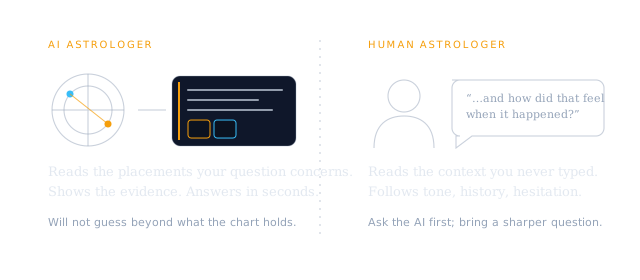
What it does instead is answer in seconds, show its evidence, and refuse to guess. AI astrology is very good at the question you have right now, at the hour you have it, in your own language. The best use of it is not as a replacement for a reading but as preparation for one: ask it until you know which placement your question is really about, then bring that placement to a person.
| AI astrologer | Human astrologer | |
|---|---|---|
| Reads | Your natal chart, today's transits, your progressed Moon | Your chart and everything you tell them |
| Answers in | Seconds | A scheduled hour |
| Shows its sources | Every sentence, as a card | If you ask |
| Follows a thread | Three questions a week free; further on Pro | For as long as the session runs |
| Will predict events | No | Depends on the astrologer |
| Cost | Free to start | Typically fifty to two hundred per hour |
07Frequently asked questions
Is the AI astrologer free?
Yes. You can ask three questions a week without paying, and each answer includes the full evidence cards. Pro removes the weekly limit and keeps your reading history.
Do I need an account or email to ask?
No email is required to ask your first question: enter your birth details and ask. An account only matters if you want your birth details saved and your questions kept in My Readings.
What does the AI astrologer actually read?
Your natal chart (planets, houses, angles, aspects), current transits to it, and your progressed Moon. It does not read your zodiac sign alone, and it does not use anything you typed in earlier questions as fact.
How accurate is AI astrology compared with a human astrologer?
The chart math is the same an astrologer uses, calculated with astronomy-engine at NASA/JPL precision. The interpretation is narrower: it answers the question you asked from the placements that concern it, and it will not speculate beyond them. A human reads context you never typed.
Will the AI astrologer predict when something will happen?
No. It shows when an influence is strongest or eases, with dates, but it frames this as timing to be aware of, not as an event that will occur.
What if I don't know my birth time?
You can still ask. Answers will skip house-based and angle-based factors and say so in the evidence cards, so you know what is missing.
Can I ask the AI astrologer about a place?
Yes. Ask whether a city suits you or compare two cities; the answer draws on your astrocartography lines and your relocated chart for those places.
What should I do after I get an answer?
Follow one of the suggested questions, or open the placement it named in your birth chart to read it in full. If the answer touched on timing, Today's Reading shows how it plays out day by day. Both run on the same chart the AI astrologer read.
08Keep going
Today's Reading
How the strongest transit to your chart plays out over the day.
Birth Chart
Every placement the AI astrologer read, in full.
Astrocartography
Your planetary lines across the world map.
Transit Chart
Today's sky against your natal chart, with exact dates.
Synastry
Two charts read together, both entered deliberately.
Relocation
Your chart recalculated for a city you are considering.