Astrocartography for Couples
Put both birth charts on one map. See where your planetary lines meet, and which cities score well for each of you, not just for one.
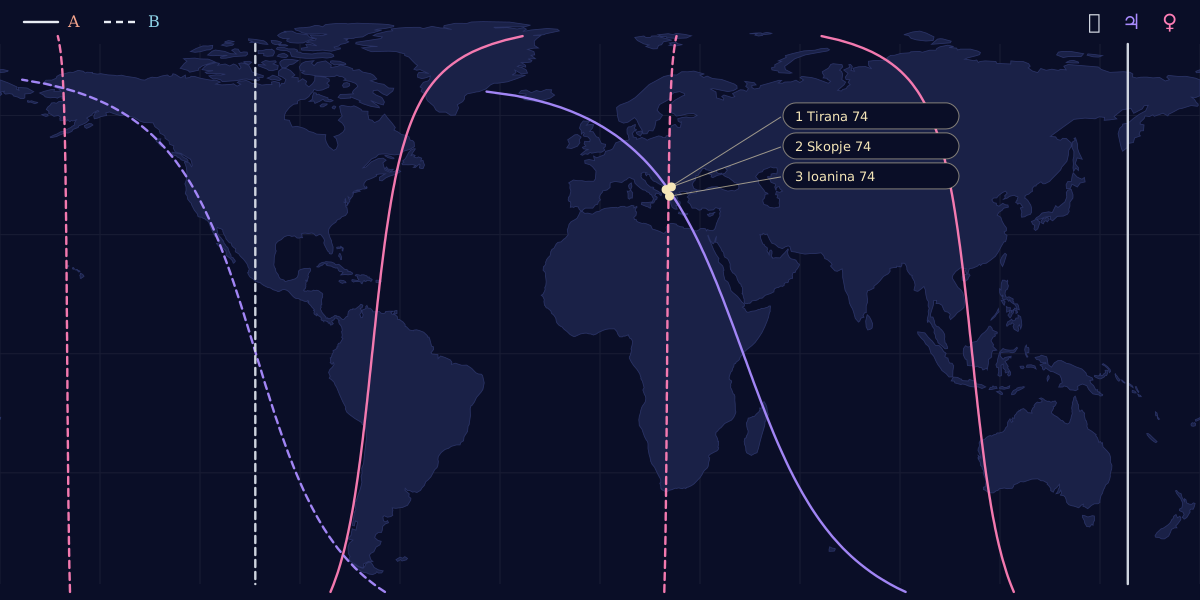
Example couple: partner A born Apr 18, 1990, 8:45 AM in Lisbon, partner B born Nov 2, 1988, 9:10 PM in Toronto. Enter your own details above.
- Top shared place · Love
- Tirana, Albania777174
- Strong for both · Love
- 108
- places where you both score 60 or more
- Best meeting point
- A ♀︎ Venus ASC × B ♀︎ Venus MCnear Cam Ranh, Vietnam · 102 km
- 20 harmonious crossings near a city
All four Venus lines, with Jupiter, the Sun and the Moon on the Descendant: where affection and partnership come easily.
Shared places · Love
AtogetherBWhere your lines cross
Your relationship's own map
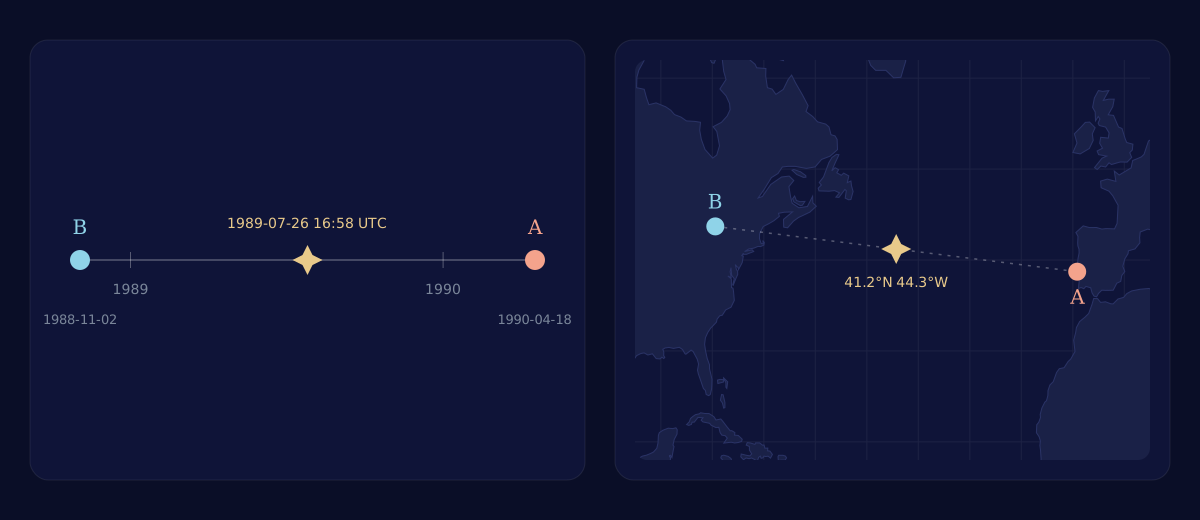
A Davison chart is cast for the moment and place halfway between your births. Its lines show where the relationship itself does well, apart from either of you.
By the AstroChart team · Updated October 30, 2026 · Lines computed with astronomy-engine (NASA/JPL ephemeris accuracy)
What is astrocartography for couples?
Astrocartography for couples puts two people's planetary lines on one world map, so you can see which places light up the same parts of both charts, and which would suit only one of you.
Ordinary astrocartography, the technique Jim Lewis introduced to the public in 1976, draws one person's planets onto the globe. Each planet gets four lines: where it was rising, setting, overhead and underfoot at the moment of birth. Astrologers say that near one of those lines, that planet's themes grow louder in your life.
Astrocartography for couples asks a harder question. A city can sit right on your Venus line and on nothing at all in your partner's chart. Moving there might feel like a love story to you and a long holiday to them. Reading both maps at once, with the same distances and the same rules, shows where the story is shared.
Shared places are rarer than people expect. Among 1,000 simulated couples, half had 1 or fewer cities where both partners scored 60 or more for love, out of 4,546 candidates, and 44% had none at all. That is why astrocartography for couples needs both charts from the start rather than one map checked against the other afterwards.
The tool above does exactly that. It draws both partners' forty lines with the same engine as our astrocartography map, scores every candidate city for each of you, and ranks the places where both scores are high.
How astrocartography for couples works: three layers
A couples map has three layers. Each one answers a different question, and the tool shows all three.
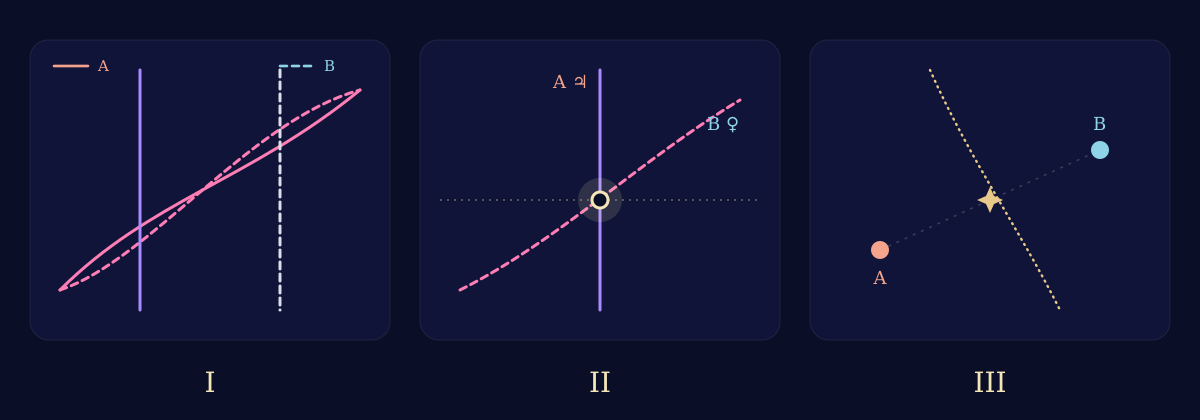
I
Both maps, one globe
Both partners' lines drawn together. Most readings start here: in a glance you see whether your Venus lines run through the same continent or opposite sides of the planet.
II
Where your lines meet
Points where one partner's line crosses the other's. At a crossing, a planet from each chart is on an angle in the same spot, so both of you feel it at once.
III
The relationship's own map
A third chart, cast for the moment and place halfway between your births. Its lines describe where the relationship itself thrives, as distinct from either of you.
In this astrocartography for couples tool, the overlay and the crossings are free. The Davison layer is part of Pro, because it is a separate chart with its own rankings.
Why a shared city has to work for both of you
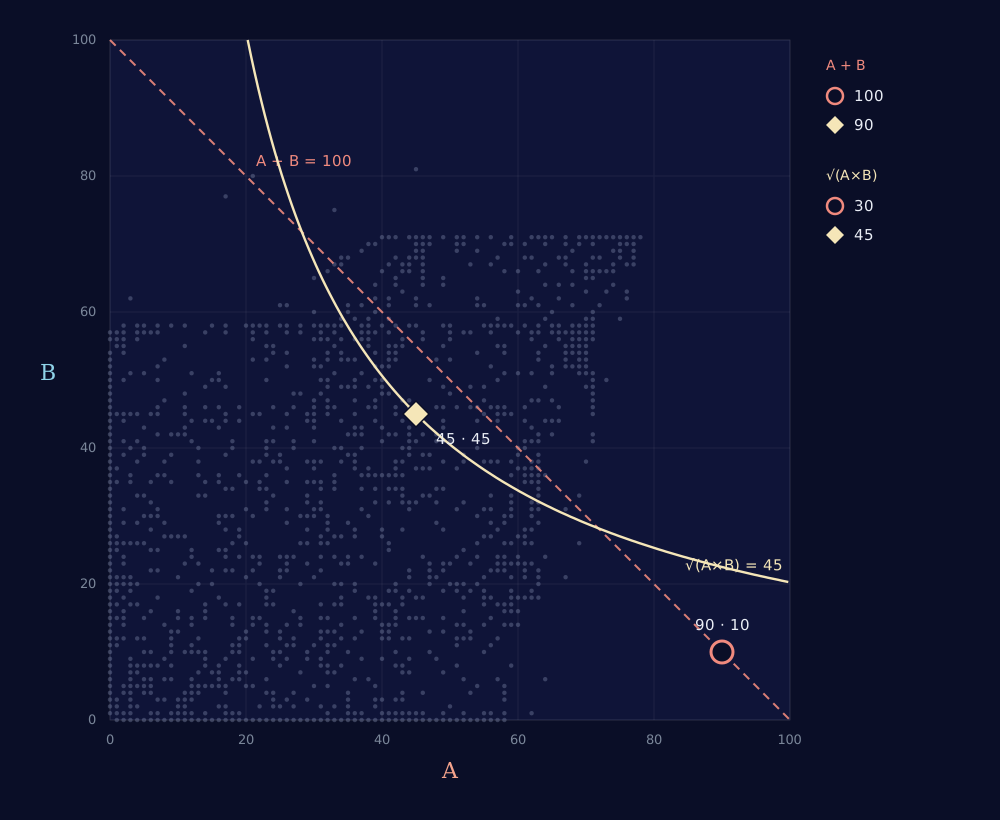
The simplest way to do astrocartography for couples is to add the two scores together. That sounds fair until you look at the cities it favours. A place where one partner scores 90 and the other 10 adds up to 100, more than a place where both score 45. On the map, that is a city one of you would love and the other would merely put up with.
So astrocartography for couples on this page multiplies instead. The couple's figure is the geometric mean, √(A × B): 90 and 10 give 30, while 55 and 55 give 55. A place has to work for both of you before it can rank.
Most of the time the two methods agree. Across our 1,000 simulated couples, they chose the same first place for love 77% of the time. For the other 23%, the city adding would have chosen had partner scores 23 points apart on average, against 14 for the city the geometric mean chose. Multiplying changes the answer exactly when one of you would be left behind.
How each score is built
- Distance
- A line counts fully where it passes, half at 450 km, and not at all beyond 900 km.
- Support
- Each theme has its own lines and weights. Venus on the Descendant counts most for love; the Moon on the IC, for home.
- Care
- Lines that ask for care, such as Saturn on the Descendant for love, can take up to 60% off a score, never all of it.
- Each partner
- A score from 0 to 100 for each of you, from the supportive lines within reach.
- Together
- √(A × B), the number in the middle of every bar.
The lines that matter most in astrocartography for couples
Not every line says the same thing about a relationship. These are the lines the love and home themes weigh most, with the reasoning astrologers usually give.
Lines that support you
Venus on the Descendant
The classic partnership line: the planet of affection on the angle of the other person. Often called the strongest love line in astrocartography.
Venus on the IC
Affection at the root of the chart: a pleasant home, and a place that feels easy to settle into.
Jupiter on the Descendant
Generous partners and good fortune through others. A line for growing together.
The Moon on the IC
The home line above all others: belonging, family and nesting.
The Sun on the Descendant
Partnership moves to the centre of life; the relationship is where you shine.
The Moon on the Descendant
Emotional closeness and quick understanding between partners.
Lines that ask for care
Saturn on the Descendant
Commitment with weight: serious and lasting, sometimes heavy. Good for building, hard on lightness.
Mars on the Descendant
Passion and friction in equal measure; arguments flare more quickly.
Pluto on the Descendant
Intensity and power struggles, and change that comes through the relationship.
Uranus on the Descendant
Excitement and surprise, with freedom put ahead of stability.
Neptune on the Descendant
Romance with soft edges: idealising, confusion and blurred boundaries.
Care lines are not deal-breakers. A Saturn line can be exactly the right place to build a business together. The tool shows them so you can see the trade-off, not to rule a city out. For what each line means in a single chart, our guide to Venus lines in astrocartography goes deeper.
Line crossings: where your two charts meet
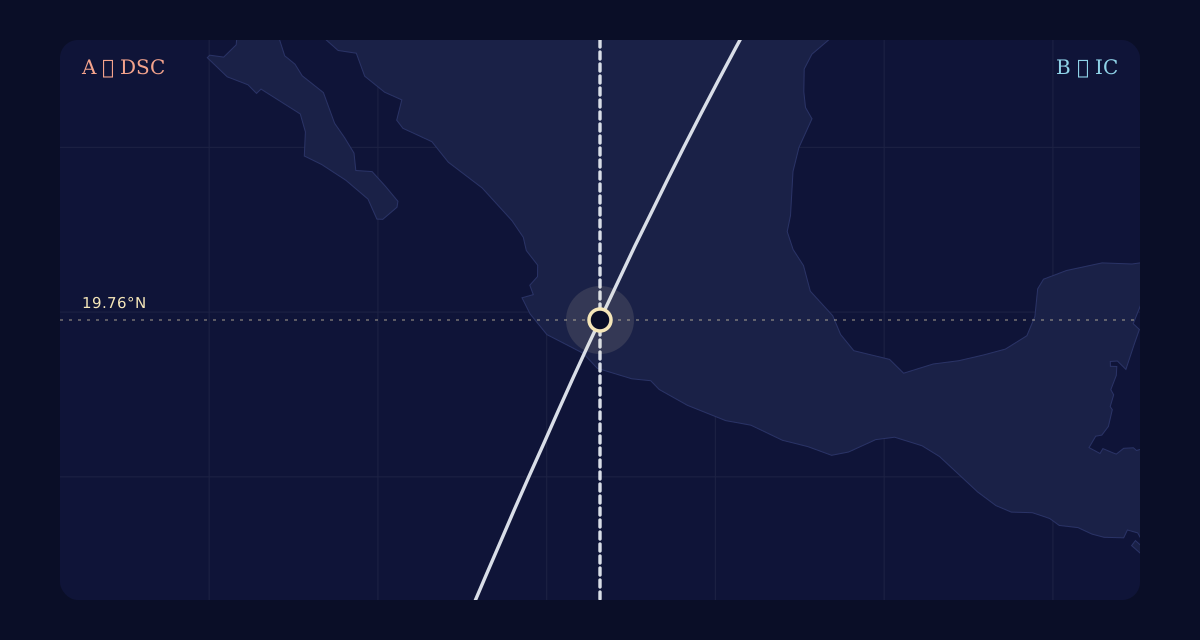
In astrocartography for couples, two lines cross where one partner's planet is on an angle in the same spot as the other's. Where your Venus line crosses your partner's Jupiter line, the planet of affection is on an angle for you and the planet of growth is on an angle for them, at the same time.
The tool finds every crossing between your two charts, keeps those inside ±66° latitude, and sorts them by the planets involved and by whether a city lies within 400 km. Pairs of the Sun, Moon, Mercury, Venus and Jupiter are marked harmonious; anything involving Mars, Saturn or Pluto, intense; the rest, mixed.
Crossings are far more common than shared cities. Across our 1,000 simulated couples, the median pair had 22 harmonious crossings within reach of a city, and not one couple had none. In astrocartography for couples, they are often the most interesting places to visit first.
Overlay, composite or Davison: which map should you read?
Relationship astrology has two well-known combined charts, and only one of them can honestly be drawn on a map for astrocartography for couples.
| Overlay | Composite | Davison | |
|---|---|---|---|
| What it is | Both natal charts, side by side | The midpoint of each pair of planets | A chart for the midpoint in time and place |
| A real moment? | Yes, two | No | Yes, one |
| Real map lines? | Yes | No | Yes |
| Best for | Where each of you thrives, and where that overlaps | The inner dynamic of the relationship | Where the relationship itself thrives |
Map lines come from sidereal time: which part of the sky stood over which part of the Earth at a real moment. A composite chart is a set of midpoints with no moment behind it, so it has no sidereal time and no true lines. Some software draws them anyway; we don't. For the composite chart itself, use our composite chart calculator.
The Davison chart, which Ronald Davison introduced in 1977, is cast for a real instant halfway between the two births, so its lines are genuine. One detail most explanations miss: the lines depend only on that instant. The midpoint place sets the Davison chart's houses but does not move a single line.
How exact do your birth times need to be?
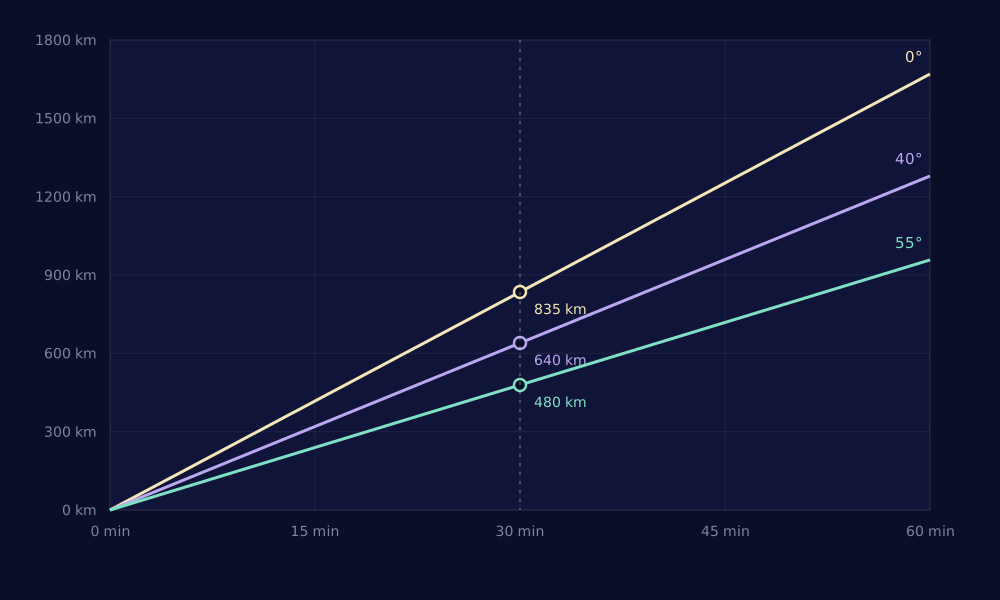
More exact than most people's are. The Earth turns one degree every four minutes, so a birth time four minutes out moves every MC and IC line by a degree of longitude, about 111 km at the equator. Half an hour moves them 7.5°: around 835 km at the equator, 640 km at 40° latitude and 480 km at 55°.
Ascendant and Descendant lines slide by the same 7.5° of longitude, so one partner's whole map moves sideways while the other's stays put. That is why astrocartography for couples needs both partners' times, not just one.
We measured how much it matters, and the answer is: a lot. Moving one partner's birth time by only 10 minutes changed the couple's first place for love in 64% of our simulated couples. Moving it by 30 minutes kept the same first place in just 12%, and kept it anywhere in the top ten in 26%.
Nor does the first place simply move next door: after a 30-minute shift, the new one lay within 1,000 km of the old in only 46% of cases. If one of you only knows a rough time, treat the list as a starting point rather than an answer, and check the time against a birth certificate or hospital record before planning a move around it.
How to use astrocartography for couples in five steps
- 1
Enter both birth details
Date, time and place for each of you. If you are signed in, your saved birth profile fills in partner A.
- 2
Pick a theme
Love, home, career or growth. Each uses its own lines, and the map shows only those until you tick All lines.
- 3
Read the shared places
Open a city to see which of each partner's lines earned the score, and which ask for care.
- 4
Check the crossings
Click one to fly to it. Harmonious crossings near a city are often the best places to visit first.
- 5
Test your own shortlist
Type any city into the checker to see both scores for all four themes.
Four ways to use astrocartography for couples
People come to astrocartography for couples with different plans. These are the four we see most.
Moving together
Compare two or three real options before a move, and see whether one of them quietly favours one of you.
Honeymoons and long trips
Choose a destination near a shared love or growth line, or close to a harmonious crossing.
Long-distance relationships
Find the places where you would both feel at home, for visits now and a shared base later.
Family, friends and business
The method works for any two people: a parent and an adult child, two friends, two business partners. Pick the theme that fits.
What astrocartography for couples can't tell you
Astrocartography for couples is about places, not about whether you are right for each other. For the relationship itself, look at your synastry chart, which shows how your planets aspect each other, or start with our compatibility calculator for a quick read.
A map also knows nothing about rent, visas, languages or jobs. Use it the way you would use a good travel guide: to choose which places deserve a closer look, then decide with everything else you know.
Questions about astrocartography for couples
Is this astrocartography for couples tool free?
Yes. Both partners' lines, the shared-place rankings for all four themes, the crossings and the city checker are free, and you don't need an account: you can make 10 couples maps a day without signing in, or 30 with a free account. The Davison relationship layer is part of Pro.
Do both partners need exact birth times?
As exact as you can get them. Thirty minutes moves the lines several hundred kilometres, and in our tests a 30-minute shift in one partner's time kept the first-place city for only 12% of couples. A birth certificate or hospital record is worth finding before you rely on the exact cities.
Can astrocartography for couples tell us if we're compatible?
No. It compares places, not people. For compatibility, look at how your planets aspect each other in a synastry chart.
What is the best astrocartography line for couples?
Venus on the Descendant is the line astrologers most often call the love line, and it carries the most weight in the love theme here. For settling down, the Moon on the IC matters more. In astrocartography for couples, the best place is usually one where each partner has one of these lines, not one where a single partner has several.
What if we have no shared places?
Then astrocartography for couples has found no city with a supportive line within 900 km for both of you, in that theme and region. Try another theme or the worldwide list, look at the crossings, or check the places you already have in mind. A city that is good for one of you and neutral for the other can still be a fine choice.
Is a Davison astrocartography map better than a composite one?
For maps, yes. The Davison chart is cast for a real moment, so its lines are real. A composite chart has no moment behind it, so it cannot have honest lines.
Can we use astrocartography for couples with friends, family or business partners?
Yes. Nothing in the calculation assumes a romantic relationship. Use home for family, career for business partners and growth for travel companions.
What should we do after we find a shared place?
Visit before you move if you can, and notice how each of you feels there. Then look at timing: the cyclocartography map shows when lines are activated, and the relocation chart shows how each of your charts changes in that city.