Relocated solar return: where to spend your birthday
Your solar return happens at one exact moment, everywhere at once, and where you stand when it happens sets the houses for the year. That is a relocated solar return. Enter your birth details to see, city by city, where that moment helps career, love, money or rest.
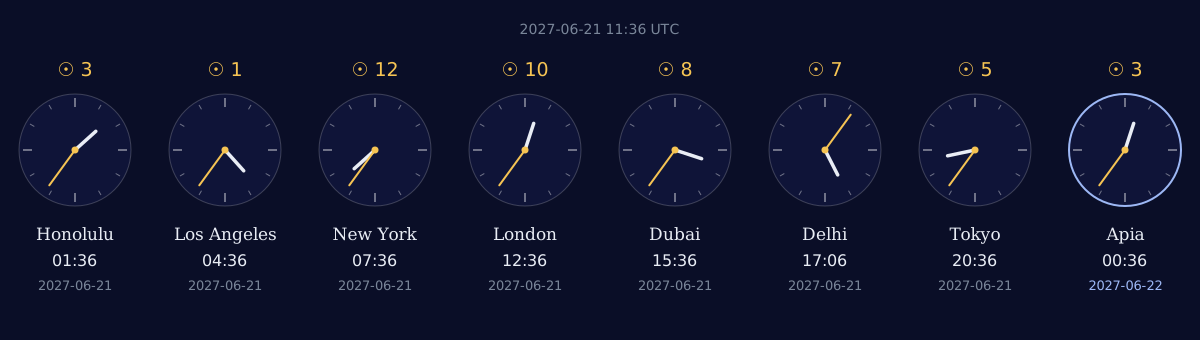
Example: born June 21, 1991 at 7:45 PM in London. Next return: June 21, 2027 at 12:36 PM. Enter your own details above.
If you stay home
London, United Kingdom
Sun in the 10th house · 12:36 PM local
72out of 100
Your 2027 solar return
June 21, 2027
12:36 PM
London, United Kingdom time · 11:36 AM UTC
Best for Career
Geneva, Switzerland
Sun in the 10th house · 1:36 PM local
88out of 100
The Sun in the 10th house, and Jupiter, Venus or the Sun on the Midheaven.
Best cities for Career
The return chart, city by city
Geneva, Switzerland
746 km from home · Jun 21, 2027, 1:36 PM
- Rising
- ♍︎ 29°52′ Virgo
- Midheaven
- ♊︎ 29°50′ Gemini
- Sun
- 10th house
- Moon
- 4th house
- On the angles
- ☉︎ SunMC0.1°
- ☿︎ MercuryMC2.9°
- Career88
- Love0
- Money63
- Rest26
Sun in the 10th house
Sun 0.1° from the MC
Mercury 2.9° from the MC
For the full reading of a city, enter it in the solar return chart.
Against your birth chart
Pro also checks every city against your birth chart: which natal house the return Ascendant falls in (the first rule of Ciro Discepolo's aimed returns keeps it out of the 1st, 6th and 12th) and whether a return angle lands on a natal planet. The lists then re-rank with both.
By the AstroChart team · Updated October 30, 2026 · Return moments checked against the Swiss Ephemeris
What is a relocated solar return?
A relocated solar return is your birthday chart cast for the place where you are when the Sun comes back to its birth position, rather than for the place you were born.
Once a year the Sun returns to the exact degree it held when you were born. Astrologers cast a chart for that moment, the solar return, and read it as the outline of the year until the next birthday. The moment is the same everywhere on Earth. The chart is not: its Ascendant, its Midheaven and its twelve houses depend on where you stand.
That is the idea behind a relocated solar return. The planets keep their signs and aspects wherever you go, but travel moves them into different houses and onto or off the angles. Spend the birthday a few time zones away and the Sun can move from the 12th house of retreat to the 10th house of career, or Jupiter can climb onto your Ascendant.
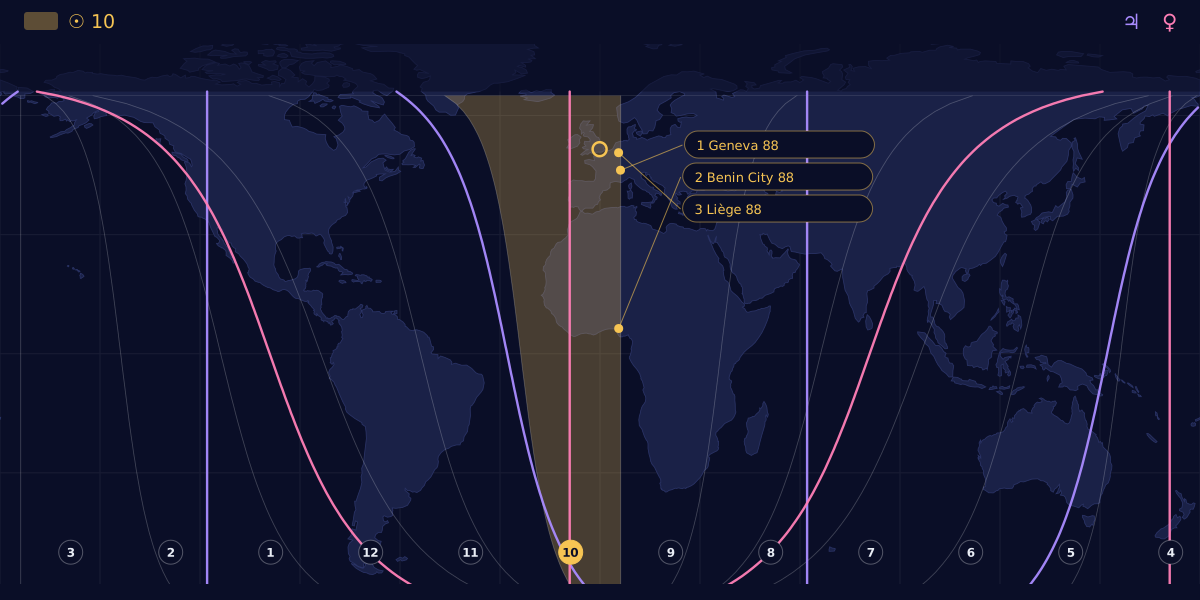
Most calculators make you pick a city first and then recast the chart for it. This page works the other way round. It casts your relocated solar return for 4,546 cities, scores each one for the goal you choose, and shows the result on a map: the zones where the return Sun lands in each house, and the lines where each planet sits exactly on an angle.
If you have never read your return before, start with the solar return chart for the city you live in, which has the full reading. Use this map when you want to know whether a trip would change it, and where to go.
What a relocated solar return changes, and what it can't
Three things decide what a relocated solar return can do. Only two of them move when you do.
I
Fixed: the moment and the sky
The return happens at one instant in UTC. At that instant every planet is in the same sign and degree, making the same aspects, for everyone on Earth. No trip can undo a Saturn square to Venus.
II
Moves: the angles and the houses
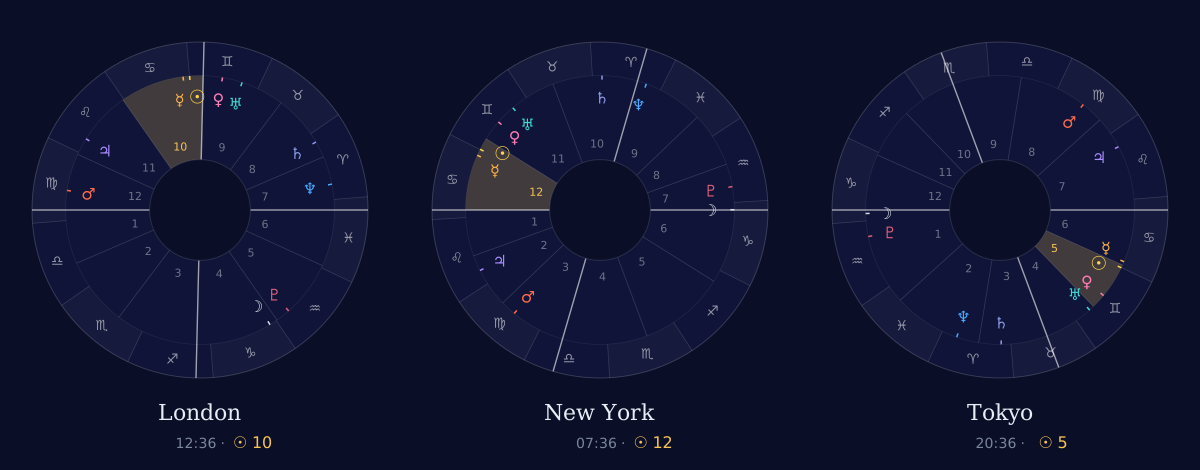
The Ascendant and Midheaven follow the local sky, so the houses turn as you travel. Going east or west turns them about one house for every 30° of longitude; going north or south mostly shifts the Ascendant and stretches the houses.
III
Matters most: what sits on an angle
A planet within a few degrees of the Ascendant, Midheaven, Descendant or IC is the loudest voice in a return chart. Travel can put Jupiter there or take Saturn away. The map draws those places as lines.
So a relocated solar return is not a different year. It is the same year with the emphasis moved: which part of life the Sun lights, and which planet speaks loudest.
The birthday clock: why the Sun's house is the local hour
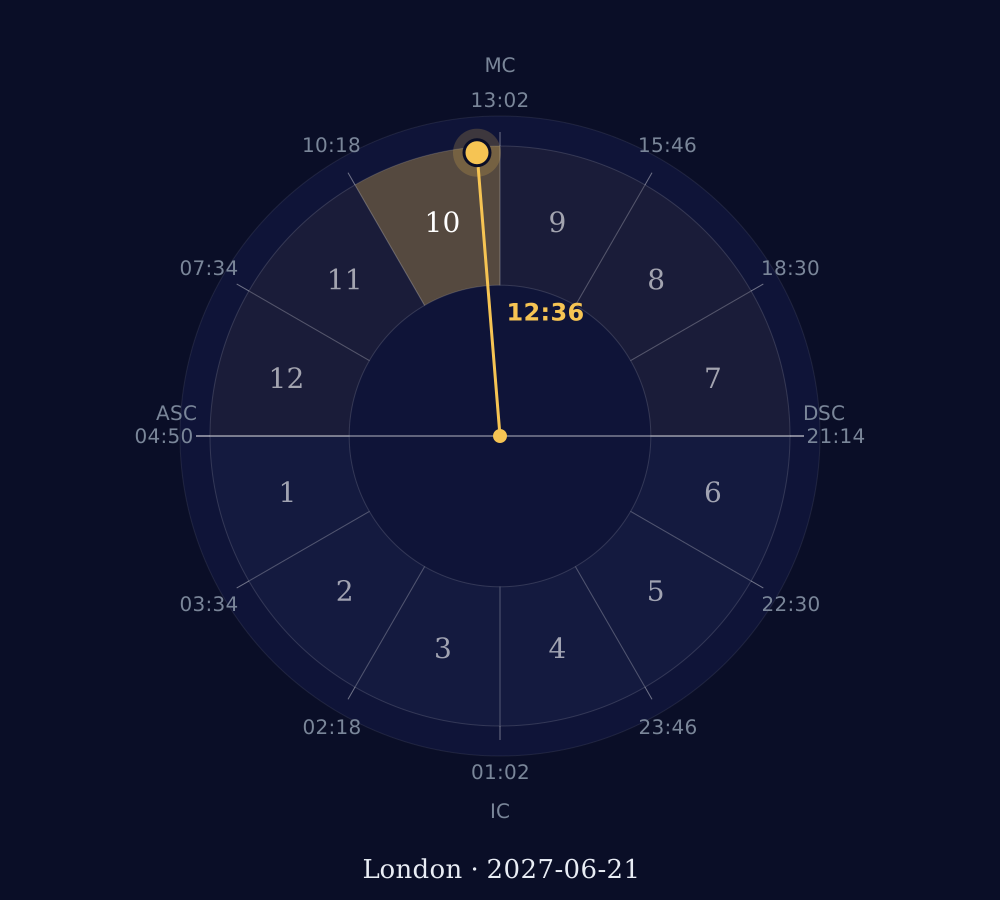
In the Placidus house system, the default for a relocated solar return here and on most sites, each point's house is set by time. Its daily arc above the horizon is cut into three equal parts on each side of its highest point, and its arc below the horizon the same way. For the Sun, that is simply the hour of the day.
In the first third of the morning after sunrise the Sun is in the 12th house; in the last third before noon, the 10th. Just after noon it is in the 9th, just after sunset in the 6th, and the hours around midnight belong to the 4th and the 3rd. The day houses are longer in summer and the night houses longer in winter, because the arcs are.
For a relocated solar return, the question "where should I spend my birthday for a career year?" turns into a question about clocks: where on Earth will it be late morning at the moment of your return? Because that moment is fixed, the answer is a band of longitude about 30° wide, and it moves every year with the time of your return.
The dial beside each city on this page is that clock. The upper half is the Sun's day, the lower half its night, each split into its houses, and the hand points at the Sun. Two cities whose hands point into the same sector share the same Sun house, however far apart they are.
How this map ranks cities for a relocated solar return
Every candidate city gets its own relocated solar return chart: Placidus houses from the same formulas as our solar return chart, and planet positions at the return moment. A city's score for a goal adds up three kinds of evidence and takes away a fourth.
The score runs from 0 to 100 and is relative. It lets you compare places for one return and one goal. It does not compare years, and it is not a forecast of how the year will go.
The method in five lines
- Moment
- The return is the moment the Sun's apparent longitude equals its apparent longitude at birth. Checked against the Swiss Ephemeris for five test births, it agreed to within 25 seconds.
- Sun's house
- The Sun's house carries the most weight. Each goal has a main house worth 1 and secondary houses worth less, listed in the four goals below.
- Angles
- A planet on an angle counts in full at 0°, half at 5° and not at all from 10°. Jupiter and Venus add; Saturn, Mars, Pluto, Uranus and Neptune take away where they make the goal harder, and on the Ascendant they take away for every goal.
- Houses
- Jupiter and Venus in the goal's houses add a little even away from the angles; Saturn and Mars in them take a little away.
- Score
- Score = 100 × (1 − e^(−support)) × (1 − 0.6 × caution, capped at 1). One strong factor scores about 63 and two about 86; a full caution takes 60% off. Cities with equal scores are listed largest first, and no two cities in a list are closer than 150 km.
Four goals, four kinds of birthday
In a relocated solar return, each goal looks for a different Sun house and different planets on the angles. These are the weights the scores use.
Career
The Sun in the 10th house above all, then the 6th (daily work) and the 11th (networks). Jupiter, the Sun or Venus on the Midheaven help most. Saturn, Neptune or Pluto on the Midheaven ask for care: weight and duty, a blurred direction, or a power struggle.
Love
The Sun in the 7th house (partnership) or the 5th (romance and pleasure). Venus or Jupiter on the Descendant or the Ascendant is the classic love placement. Saturn, Mars or Pluto on the Descendant count against it.
Money
The Sun in the 2nd house (income and what you own) or the 8th (shared money, debts and investments), then the 11th and 10th. Jupiter or Venus on the Midheaven, Ascendant or IC help. Neptune or Saturn on the money angles count against.
Rest
The Sun in the 4th house (home and roots) or the 12th (retreat), then the 9th. Jupiter, Venus or the Moon on the IC help, and hard planets on the IC or Midheaven count against, since a quiet year is mostly about what is not loud. Some schools treat the 12th as the house to avoid; if you follow them, pick a city in a 4th-house zone.
Whatever the goal, a hard planet on the Ascendant counts against the city: Saturn, Mars, Pluto, Uranus or Neptune there colours the whole year.
How far do you need to travel for a relocated solar return?
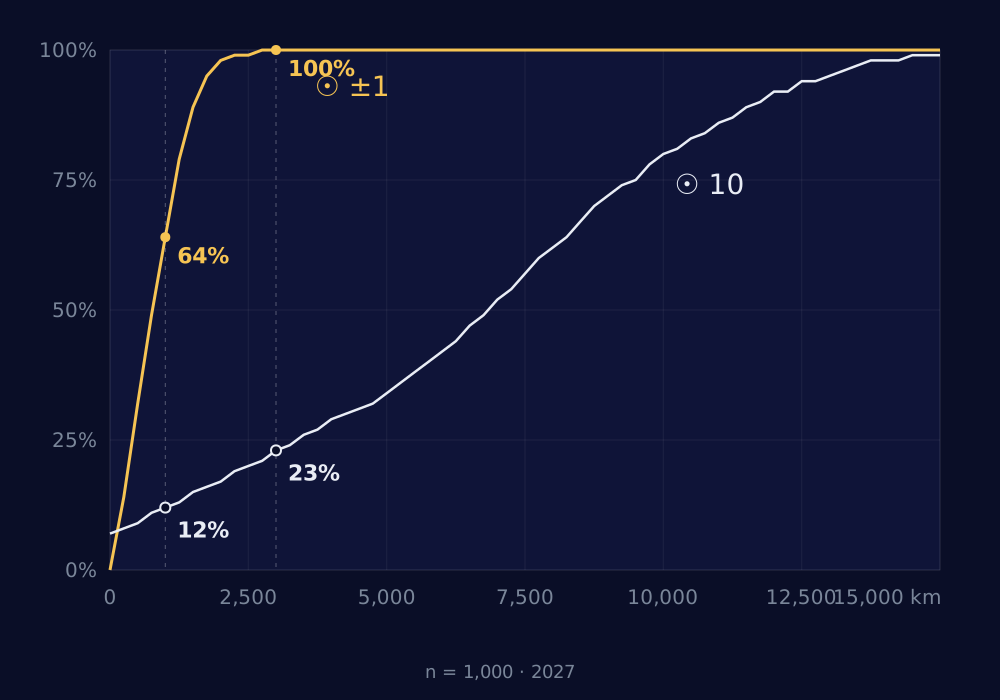
Less than people expect for a change, more than they hope for a particular house. Across 1,000 simulated births with a 2027 return, the nearest city where the Sun changes house was a median 760 km from home, and 64% of people had one within 1,000 km.
A particular house is another matter. To put the Sun in the 10th house, the median trip was 6,830 km, and for 90% of people the best career city on the whole map was 3,000 km or more from home. The best city anywhere scored a median 60 points above staying home; the best within 1,000 km, 13 points.
Short trips still matter for the angles. At home, 39% of returns had Mars, Saturn, Pluto or Uranus within 5° of an angle, and for 97% of those a city within 1,000 km took every one of them off the angles. That is what the 1,000 km lists are for: they rarely move the Sun far, but they often move Saturn.
Be there at the moment
A relocated solar return is cast for one instant, so the city that counts is the one you are in at that minute, not the one you sleep in that night. Every list on this page gives the local time of the return in each city.
The local date can surprise you. The return can fall on the day before or after your birthday: at the birthplace it did for 26% of the simulated births, and away from home it happens more often, because the same instant can already be tomorrow in Tokyo or still yesterday in Honolulu.
Astrologers who work with the relocated solar return usually suggest arriving a day early, both for travel delays and because some read the hours before the return as part of it. There is no agreed rule on how long to stay; the chart only asks that you are there when the Sun returns.
Why these lines differ from your astrocartography map
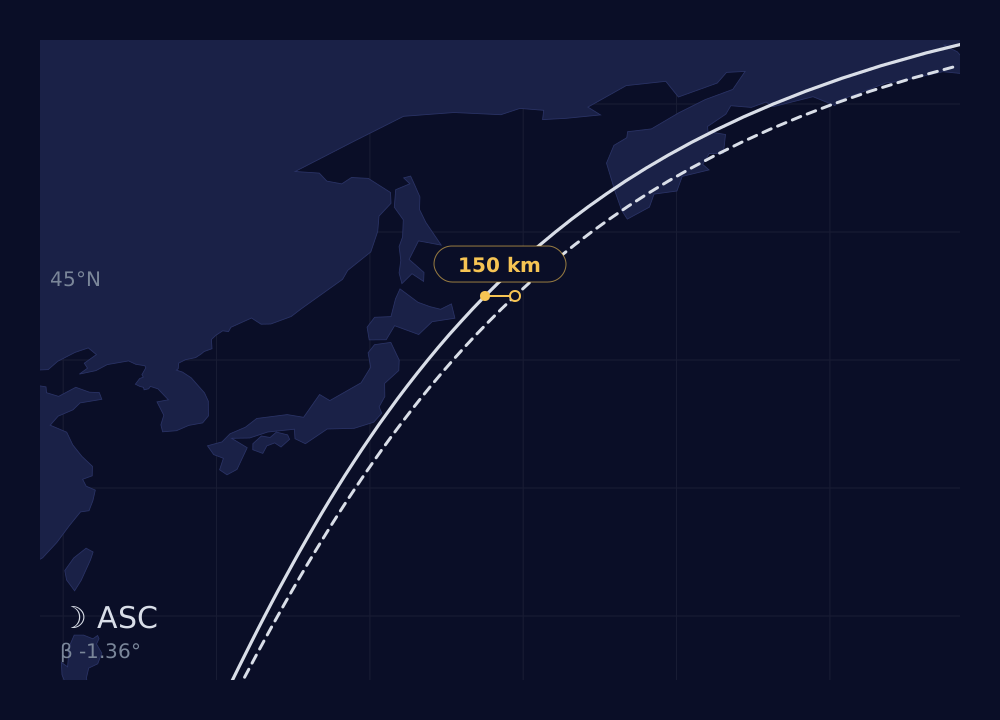
The lines on this map are zodiacal. Each one marks where a planet's degree of the zodiac sits exactly on the Ascendant, Midheaven, Descendant or IC of your return chart. That is what a return chart measures, so a city on this map's Jupiter Midheaven line shows Jupiter exactly on the Midheaven in its chart wheel.
A classic astrocartography map, including our birth chart map, draws where the planet's body rises and culminates, and planets do not sit exactly on the ecliptic. For the Sun the two lines are the same. In our simulation, Venus's Midheaven line moved by a median 30 km (up to 100 km) and its Ascendant line at 45° latitude by 100 km (up to 260). The Moon's moved 80 km on the Midheaven and 300 km on the Ascendant, up to 620 km.
Neither line is wrong; they answer different questions. For reading a relocated solar return, the zodiacal line is the one that matches the wheel.
Does a birthday trip really change your year?
Astrologers disagree about the relocated solar return, so here are both sides.
The case for
The Italian astrologer Ciro Discepolo built a whole method, aimed solar returns, on travelling for the birthday, with rules such as keeping the return Ascendant out of the natal 1st, 6th and 12th houses. His followers have practised it for decades, and most astrologers cast the return for wherever the client actually is.
The case against
Others cast every return for the birthplace or for home, arguing that you come back to the same life after a few days, and some see a strategic trip as a way of dodging the year's lesson. There is no controlled study either way, and one good or bad year after a trip proves nothing on its own.
Our view: read the chart for where you will actually be. If you are travelling anyway, choose the city with care. If a long trip is out of reach, the 1,000 km list is often enough to take a hard planet off an angle.
How exact does your birth time need to be?
More exact than for most charts, because a relocated solar return hangs on one minute. That minute depends on the Sun's degree at birth, and the Sun moves about a degree a day, so a birth time ten minutes out moves the return by about ten minutes too: a median 10 minutes in our simulation.
Ten minutes of sky time turns the whole map by 2.5° of longitude, about 280 km at the equator and 200 km at 45° latitude. With the birth time ten minutes later, the top career city stayed in the top ten for only 16% of the simulated births, and the new number one was a median 770 km from the old.
If your birth time is rounded or remembered, check a birth certificate before you book anything, and favour a city in the middle of a lit zone over one at its edge.
How to plan a birthday trip in five steps
- 1
Enter your birth details
Date, exact time and place of birth, plus where you live now. The page finds the moment of your next relocated solar return to the second.
- 2
Pick a goal
Career, love, money or rest. The map lights the zones where the Sun falls in that goal's houses.
- 3
Set how far you'll go
Anywhere, within 3,000 km or within 1,000 km of home. Compare the top city with the stay-home card.
- 4
Read the city's chart
Open a city to see its return chart: rising sign, the Sun's and Moon's houses, planets on the angles and all four scores.
- 5
Be there at the moment
Note the local time of the return, arrive a day early, and enter the city in the solar return chart for the full reading.
Relocated solar return: questions
Does traveling on your birthday change your solar return?
It changes the houses and the angles, not the planets. Where you are at the exact moment of the return sets the Ascendant, Midheaven and houses of the chart, so a relocated solar return can move the Sun from one house to another or put a planet on an angle. The signs and aspects stay the same everywhere.
What is a relocated solar return?
A relocated solar return is a solar return chart cast for where you are at the moment of the return instead of your birthplace. Most astrologers cast the return for the actual location; some keep the birthplace whatever happens.
How far do I need to travel for my solar return?
For any change of Sun house, a median 760 km in our simulation of 1,000 births; for a 10th-house Sun, a median 6,830 km. Shorter trips often take a hard planet off an angle.
Do I have to be there at the exact moment?
Yes. The chart is cast for one instant, so check the local time in the list, which can fall on the day before or after your birthday, and arrive early.
Is this relocated solar return map free?
Yes. The map, the rankings for all four goals and three distances, every city's chart and the stay-home comparison are free, with 10 maps a day without an account and 30 with a free account. Pro adds a layer that checks each city against your birth chart.
Which house system do you use?
Placidus, the usual choice for a relocated solar return and the same as our solar return chart, because the Sun's house then follows the local hour. Placidus has no houses beyond about 66° of latitude, so cities there are not ranked.
Why is my best city somewhere I've never heard of?
The ranking follows the sky, not tourism: the best place for a 10th-house Sun is wherever it is late morning at your return. Among cities with the same score we list the larger one first; switch to 3,000 km or 1,000 km for places within reach.
Can I use this for a lunar return?
Not yet. A lunar return comes every 27 days and is cast the same way, but this map is built for the solar return.