Planets in retrograde right now
A live board of all eight planets that go retrograde: which planets are in retrograde right now, which are in their shadow, when each turns, and every retrograde of the next two years, in your own time zone.
5 planets are retrograde right now: Mercury, Venus, Saturn, Uranus, and Neptune.
- Mercury♏︎ Scorpio 17° ℞Retrograde13 days left
Oct 24 → Nov 13
- Venus♎︎ Libra 26° ℞Retrograde14 days left
Oct 3 → Nov 14
- Mars♌︎ Leo 18°Directin 71 days
Next: Jan 10 → Apr 1
- Jupiter♌︎ Leo 24°Pre-shadowin 43 days
Turns retrograde Dec 13
- Saturn♈︎ Aries 9° ℞Retrograde40 days left
Jul 26 → Dec 10
- Uranus♊︎ Gemini 4° ℞Retrograde100 days left
Sep 10 → Feb 8
- Neptune♈︎ Aries 2° ℞Retrograde42 days left
Jul 7 → Dec 12
- Pluto♒︎ Aquarius 3°Post-shadowclears in 99 days
Turned direct Oct 16 · shadow until Feb 7
Next turning points
- in 13 days
Mercury turns direct
Nov 13, 2026, 3:52 PM · ♏︎ 5°
- in 14 days
Venus turns direct
Nov 14, 2026, 12:21 AM · ♎︎ 22°
- in 40 days
Saturn turns direct
Dec 10, 2026, 11:23 PM · ♈︎ 7°
- in 42 days
Neptune turns direct
Dec 12, 2026, 10:14 PM · ♈︎ 1°
- in 43 days
Jupiter turns retrograde
Dec 13, 2026, 12:59 AM · ♌︎ 27°
- in 71 days
Mars turns retrograde
Jan 10, 2027, 1:01 PM · ♍︎ 10°
Every retrograde, this year and next
Solid bars: retrograde. Faint bars: the shadows either side. Dates in UTC.
By the AstroChart team · Updated October 30, 2026 · Stations from astronomy-engine, checked against the Swiss Ephemeris
Which planets are retrograde right now, and what that means
A planet is retrograde when, seen from Earth, it appears to move backwards through the zodiac. The board above shows which planets are in retrograde right now and which are about to turn.
Every planet from Mercury outwards does this, because Earth overtakes the outer planets and is overtaken by the inner ones. For the weeks or months around that pass, the planet's daily motion along the zodiac runs backwards. The two moments where it stops and turns are the stations.
So at any moment some planets are retrograde and some are not. On a typical day two of the eight are, and on 10.7% of days between 1950 and 2039 none were. The board reads the stations to the minute and counts down in your own time zone, so the planets in retrograde right now are listed as they are, not as of last week.
Each row of the board gives the phase of a planet, retrograde right now or not: retrograde, in the shadow before or after it, or direct. The shadow is the stretch where a planet crosses the same degrees it will cover, or has just covered, backwards; many astrologers read it as part of the retrograde's story.
Mercury, Venus and Mars have their own pages with the full timeline, the loop on the sky and where each retrograde falls in your chart: Mercury retrograde, Venus retrograde and Mars retrograde.
How often each planet goes retrograde
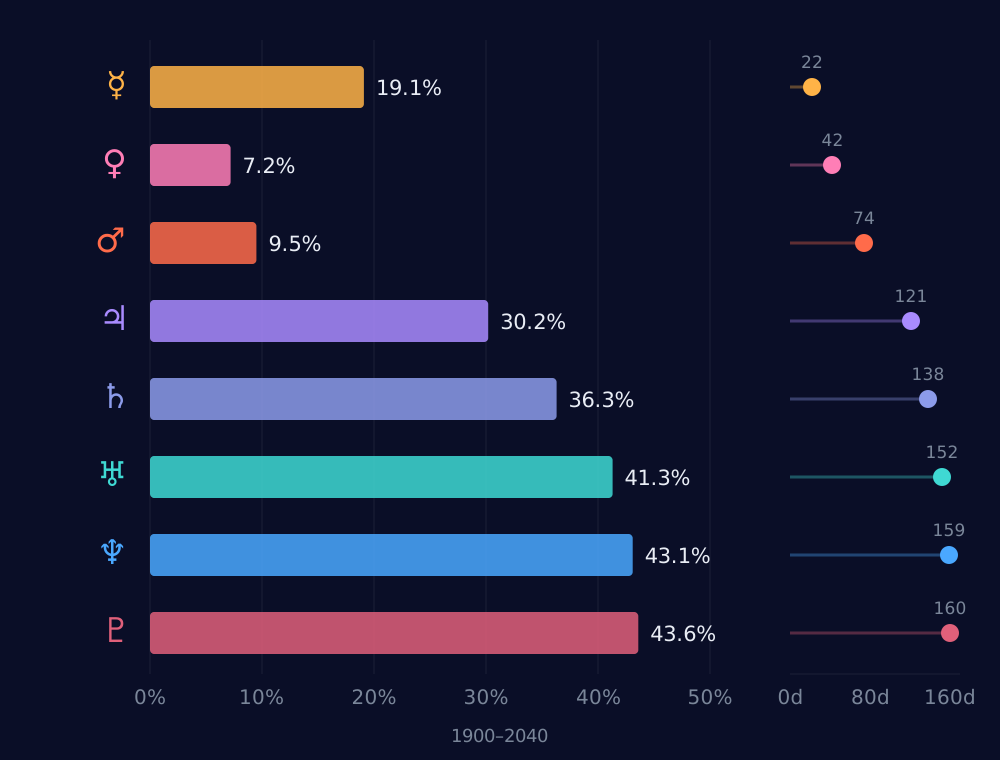
Venus and Mars are retrograde least of all: Venus 7.2% of the time, about once every 19 months for 42 days, and Mars 9.5%, about once every two years for 60 to 81 days. Mercury turns back far more often, about 3.15 times a year for around 22 days, which adds up to 19.1% of the time.
The outer planets are the opposite. Jupiter is retrograde 30.2% of the time, Saturn 36.3%, Uranus 41.3%, Neptune 43.1% and Pluto 43.6%, each for four to five and a half months a year. That is why there is almost always at least one planet in retrograde right now, and why astrologers treat the outer retrogrades as background rather than events.
These figures come from every retrograde between 1900 and 2040 in the same table that drives the board, so the averages and the live dates agree.
Because the outer planets spend so long backwards, the list of planets in retrograde right now changes slowly for most of the year and quickly around their stations. In the 2020s Pluto turns retrograde around May, Neptune around July and Uranus around September, so for a few weeks each September and October all three are retrograde right now together, before Pluto turns direct in October.
How many planets are retrograde at once?
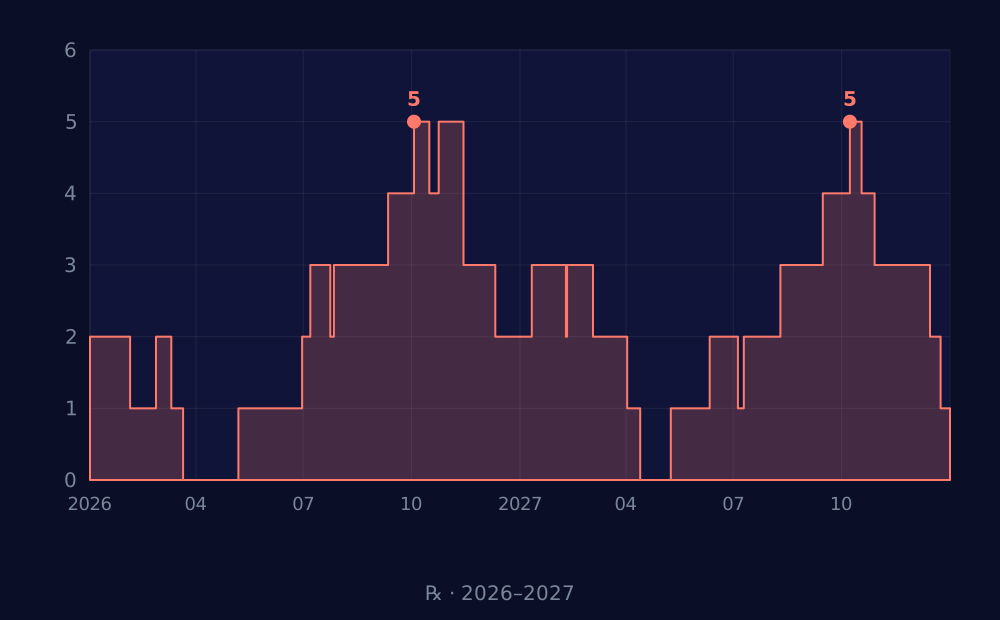
Two is the typical number. Counting every day from 1950 to 2039, the median was two planets retrograde, four or more were retrograde on 21% of days, and on 10.7% of days none was. The most on record in that span was 7, and the longest stretch with no planet retrograde lasted 88 days.
2026 and 2027 are about average. In 2026 the busiest stretch had 5 planets retrograde together on 34 days, with 47 days when none was; in 2027 the most is 5 at once, on 10 days, and 26 days have no planet retrograde at all.
When many planets are retrograde right now, astrologers tend to read it as a time for review rather than launches, but most of those planets will be the slow outer ones. A day with Mercury, Venus or Mars among them is the one astrologers notice.
Shadows and stations
Before a planet turns retrograde, it first crosses the degree where it will later turn direct: that starts the pre-shadow. After it turns direct, it needs a while to return to the degree where it turned retrograde: that ends the post-shadow. The board shows both, so you can see a retrograde coming and see it clear.
At a station the planet slows to a near standstill, so astrologers often treat the days around it as the most concentrated part of the cycle. The list of next turning points gives every station across the eight planets in the order they happen.
Stations are instants, and a station near midnight falls on a different calendar date in different places. That is why the board uses your time zone and counts calendar days on your own clock.
A planet can sit in its shadow while another is retrograde, so the board gives each row its own phase. If you only want to know which planets are in retrograde right now, read the coral rows; the amber ones are on their way into or out of a retrograde, and the silver ones are moving forward.
A short guide to each retrograde
What astrologers traditionally associate with each planet's retrograde, with how often it comes round, so you can read the board at a glance whichever planets are retrograde right now. These are interpretations, not findings.
Mercury
About 3.15 times a year, 22 days each. Communication, plans, travel and technology: a time to review, revise and double-check rather than sign and launch.
Venus
About once every 19 months, 42 days. Love, money and values: old relationships and old tastes come back for a second look.
Mars
About once every two years, 74 days on average. Drive and conflict: energy turns inward, plans stall, and strategy beats force.
Jupiter
Once a year, about 121 days. Growth and belief: expansion turns inward, a time to digest what has already been gained.
Saturn
Once a year, about 138 days. Structure and responsibility: commitments and limits come up for review.
Uranus
Once a year, about 152 days. Change and freedom: the urge to break out turns inward before it acts.
Neptune
Once a year, about 159 days. Dreams and illusions: what was blurred becomes easier to see.
Pluto
Once a year, about 160 days. Power and transformation: slow, private change beneath the surface.
Reading a busy retrograde season
Some stretches stack retrogrades. In October and early November 2026, 5 planets were retrograde together for 34 days, and the list of planets in retrograde right now ran to more than half of the eight. Astrologers often describe such seasons as a collective pause: projects slow down, old matters come back, and plans need a second look.
Others point out that the slow outer planets make up most of that count, so how a busy season feels depends on whether Mercury, Venus or Mars is among the planets retrograde right now. A common, practical reading is to use these weeks to finish, revise and repair, and to keep new launches for when the personal planets are moving forward again.
The board shows exactly when that is, and the next turning points give the dates to plan around. For your own chart, the Mercury, Venus and Mars pages show which houses each retrograde runs through, and our checker shows which planets were retrograde when you were born.
Retrograde dates 2026–2028
Every retrograde under way at some point in each year, from the station retrograde to the station direct, with the signs it covers and its shadow; one that began the year before is marked. Dates are in UTC; the board above shows times in your own zone.
Retrogrades in 2026
| Planet | Retrograde | Shadow |
|---|---|---|
| Mercury |
|
|
| Venus |
|
|
| Mars | Not retrograde this year | |
| Jupiter |
|
|
| Saturn |
|
|
| Uranus |
|
|
| Neptune |
|
|
| Pluto |
|
|
Retrogrades in 2027
| Planet | Retrograde | Shadow |
|---|---|---|
| Mercury |
|
|
| Venus | Not retrograde this year | |
| Mars |
|
|
| Jupiter |
|
|
| Saturn |
|
|
| Uranus |
|
|
| Neptune |
|
|
| Pluto |
|
|
Retrogrades in 2028
| Planet | Retrograde | Shadow |
|---|---|---|
| Mercury |
|
|
| Venus |
|
|
| Mars | Not retrograde this year | |
| Jupiter |
|
|
| Saturn |
|
|
| Uranus |
|
|
| Neptune |
|
|
| Pluto |
|
|
How to plan around retrogrades
- 1
Check the board
See which planets are in retrograde right now and which are in their shadow, in your own time zone.
- 2
Note the next turns
The stations are the turning points; the list shows the next six across all eight planets.
- 3
Add them to your calendar
One file adds every retrograde of the next twelve months, each from its first station to its last.
- 4
Go deeper where it matters
For Mercury, Venus and Mars, open the planet's page to see where its retrograde falls in your chart.
Retrogrades: questions
How many planets are in retrograde right now?
As of October 31, 2026, 5 planets are retrograde: Mercury, Venus, Saturn, Uranus, and Neptune. The board above updates to the minute in your time zone.
Which planets are retrograde in 2027?
In 2027, these planets are retrograde at some point: Mercury, Mars, Jupiter, Saturn, Uranus, Neptune, and Pluto. Mercury turns retrograde 3 times. Venus is not retrograde at all that year. The table on this page lists each retrograde with its dates and signs.
Is it bad when several planets are retrograde?
Not in itself, however many planets are in retrograde right now. Two at once is ordinary, and on a typical day most of those are slow outer planets. Astrologers read many retrogrades as a time to review and finish rather than to start, and pay most attention to Mercury, Venus and Mars.
How long does each retrograde last?
On average: Mercury 22 days, Venus 42, Mars 74, Jupiter 121, Saturn 138, Uranus 152, Neptune 159 and Pluto 160, from station to station.
When will no planet be retrograde?
Days with no planet retrograde made up 10.7% of the days from 1950 to 2039. The next one after October 31, 2026 is April 13, 2027.
What is a retrograde shadow?
The stretch before and after a retrograde when the planet moves forward over the same degrees it retraces. The pre-shadow starts when it first reaches the degree of its later station direct; the post-shadow ends when it gets back to the degree of its station retrograde.
Can the Sun or Moon go retrograde?
No. Seen from Earth, the Sun and Moon always move forward through the zodiac. Only the planets have retrograde periods.
Why are the planets in retrograde right now different from another site's list?
Usually a time zone or a stale list of planets in retrograde right now. Stations are instants, so a list in another zone can be a day apart, and some trackers are not updated. This board reads the stations to the minute and updates every minute.