Eclipses 2027: Dates, Paths and Your Chart
Every solar and lunar eclipse of the next three years, on your own clock: the zodiac degree and lunar node, the path of totality, what you will see from your city, and the house each eclipse falls in for you.
Upcoming eclipses · UTC
Annular solar eclipse in Aquarius
February 6, 2027 · in 82 days
- Greatest eclipse
- Sat, Feb 6, 16:00 UTC
- Exact new Moon
- 17°38′ Aquarius · 15:57
- Lunar node
- North node, 3.3° away
- Longest ring of fire
- 7 min 51 s, near Osório, Brazil
- Visible from
- South America, Africa
- Eclipse family (Saros)
- 18 years earlier: Annular solar eclipse, January 26, 2009
Next: Annular solar eclipse, February 16, 2045
The path crosses: Accra (Ghana), Mar del Plata (Argentina), Sekondi (Ghana), Bahía Blanca (Argentina), Punta del Este (Uruguay), Koforidua (Ghana)
See it from
Choose a city to see what this eclipse looks like there.
Band: where the ring of fire is seen. Dot: the longest annular phase.
Which house is each eclipse in your chart?
Enter your birth date, time and place, or use your saved profile. You will see the house each eclipse falls in, the opposite house on its axis, and any planet or angle it lands on within 3°.
Every upcoming eclipse in your calendar app, kept up to date.
By the AstroChart team · Updated November 10, 2026 · Eclipses from astronomy-engine, checked against the Swiss Ephemeris
Eclipses in astrology: a new or full Moon on the nodes
An eclipse is a new Moon or a full Moon that happens close to one of the lunar nodes, the two points where the Moon's path crosses the Sun's. At an ordinary new Moon the Moon passes above or below the Sun; near a node it lines up exactly, and its shadow falls on the Earth. At an ordinary full Moon the Moon misses the Earth's shadow; near a node it passes through it and turns dark or coppery.
Because the Sun reaches each node about once every six months, eclipses come in seasons: a solar and a lunar one two weeks apart, sometimes three in a row. 2027 has 5 eclipses, 2 solar and 3 lunar.
In astrology an eclipse is a lunation with the volume turned up: a new Moon that opens a chapter or a full Moon that closes one, made stronger because the nodes are involved. Astrologers read where it falls in your chart (the house) and what it touches (a planet or an angle within a few degrees). The figure shows every one from 2026 to 2030 with the sign of the north node: as the node moves backwards through the zodiac, they follow it.
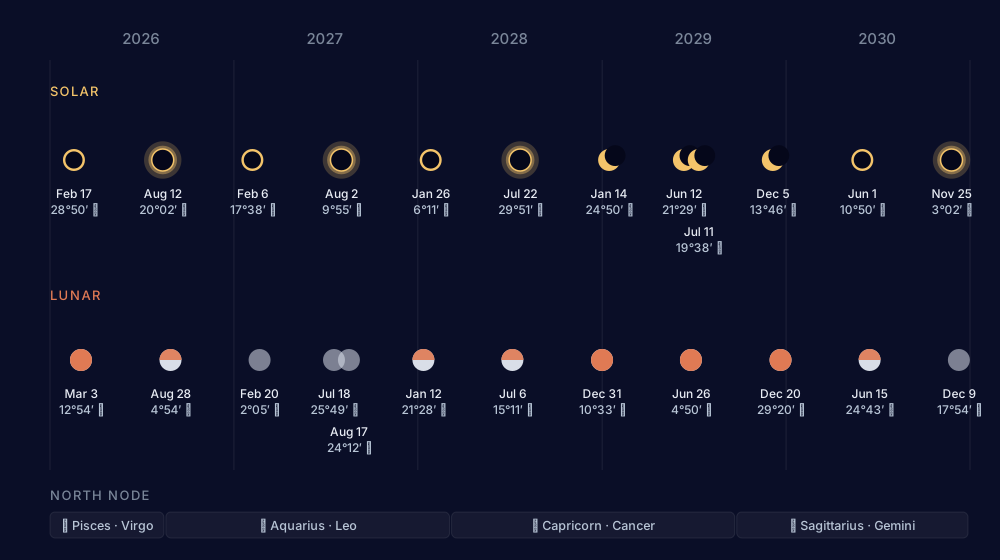
Solar and lunar eclipses
Both kinds come from the same alignment, seen from opposite sides, and astrologers read them in opposite directions.
Solar eclipse: a door opens
The Moon passes between the Earth and the Sun at a new Moon. When it is total, it covers the Sun completely along a narrow path; when it is annular, the Moon is too far from us and leaves a ring of fire; off the path, people see only part of the Sun covered. Astrologically it is a new Moon with extra weight: beginnings you did not quite choose, a new direction in the house it falls in, things that start now and unfold over the next six months to a year.
Lunar eclipse: something comes to a head
The Earth passes between the Sun and the Moon at a full Moon, and the Moon moves through the Earth's shadow. Anyone with the Moon above the horizon sees it at the same moment. When it is total the Moon turns red; when partial, a dark bite moves across it; when penumbral, it only dims, often too little to notice. Astrologically it is a full Moon with extra weight: endings, revelations, a situation reaching its peak.
A penumbral lunar eclipse is the faintest kind: the Moon only enters the Earth's outer shadow. Astrologers still count it, but usually read it as the quietest of its season.
Eclipse seasons and the Leo–Aquarius axis
The lunar nodes move backwards through the zodiac, one pair of opposite signs about every eighteen months. Eclipses follow them, so for a year and a half they keep landing on the same two signs. In the summer of 2026 the nodes moved into Leo and Aquarius, and most of 2027's fall on that axis: the annular one of 6 February at 17°38′ Aquarius and the total one of 2 August at 9°55′ Leo.
Not every eclipse fits the new axis neatly. The penumbral one of 20 February 2027 at 2°05′ Virgo is a late echo of the Virgo–Pisces series that began in 2024, and the faint one of 18 July 2027 in Capricorn is a first touch of the next one. From early 2028 the nodes are in Capricorn and Cancer, and in 2029 they move on to Gemini and Sagittarius.
For your chart this means the eclipses of a series keep returning to the same pair of houses. If the Leo–Aquarius eclipses fall across your 4th and 10th houses, home and career are the theme until 2028, and the tool above shows which degree comes when.
How to find which house an eclipse falls in
- 1
Enter your birth details
Date, time and place. The time decides the houses; if you do not know it, you get solar houses instead.
- 2
Read the house and its axis
Each eclipse lands in one house and works along the axis to the opposite one: the 1st and 7th, the 2nd and 8th, and so on.
- 3
Look for hits
A planet or angle within 3° of the eclipse degree, or exactly opposite it, is the strongest signal in the table.
- 4
Check the date and the place
Each row opens it in the tool above: the exact time on your clock, the path, and what you will see from your city.
We use Placidus houses, the system most Western astrologers use and the one our birth chart calculator shows. Many astrologers prefer whole-sign houses, where the whole sign on the Ascendant is the 1st house. The two disagree when an eclipse falls near a house cusp, so where they do, the table shows the whole-sign house as well. That is also why two Aquarius eclipses, at 6° and 18°, can land in different houses of the same chart.
Without a birth time there are no houses to speak of, so we count from your Sun sign instead (solar houses: the sign of your Sun is the 1st house). The Moon moves about 13° a day, so when the time is unknown we leave it out of the hits, along with the Ascendant and the Midheaven.
When an eclipse hits a natal planet
The house says where in your life an eclipse plays out. A hit says who it is about. When the eclipse degree falls within 3° of a natal planet or angle, or opposite it, that point is the one astrologers expect to feel it: the Sun for direction and identity, the Moon for home and feelings, Venus for love and money, Saturn for duty and structure, the Ascendant for the body and how you meet the world, the Midheaven for work and reputation.
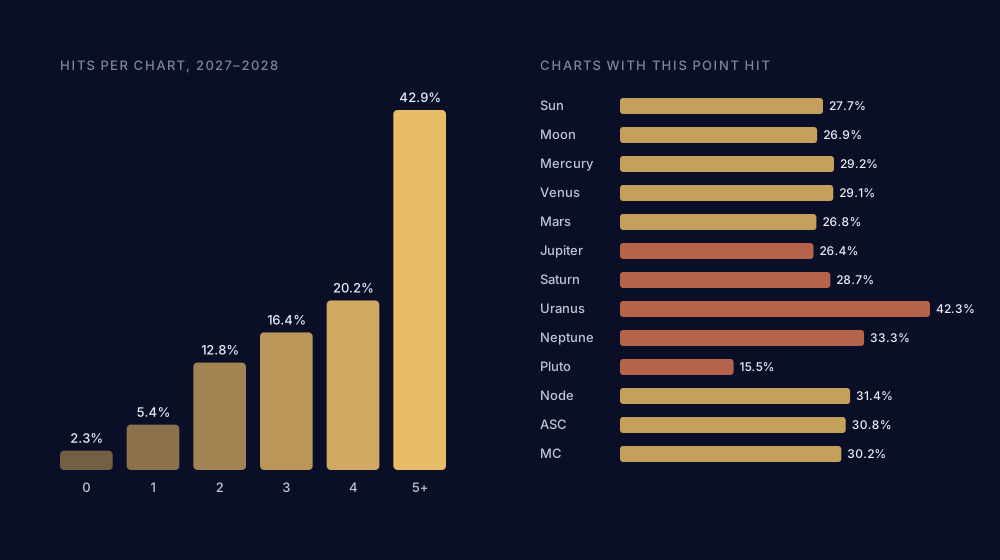
Hits are not rare. We placed the ten eclipses of 2027 and 2028 in 1,000 simulated birth charts: 97.7% had at least one point within 3°, 89.5% had a personal point hit (Sun, Moon, Mercury, Venus, Mars, Ascendant or Midheaven), and the median chart took 4 hits. Only 2.3% had none.
What makes a hit stand out is closeness and the point involved. A 0.3° conjunction to your Sun is a different event from a 2.8° opposition to Neptune. The figure shows one more pattern: Uranus is hit in 42.3% of charts and Pluto in only 15.5%, because the outer planets stay in one sign for years and whole generations share them. People born with Uranus in Leo, Aquarius or Capricorn feel this run of eclipses together.
The Saros echo: look back 18 years
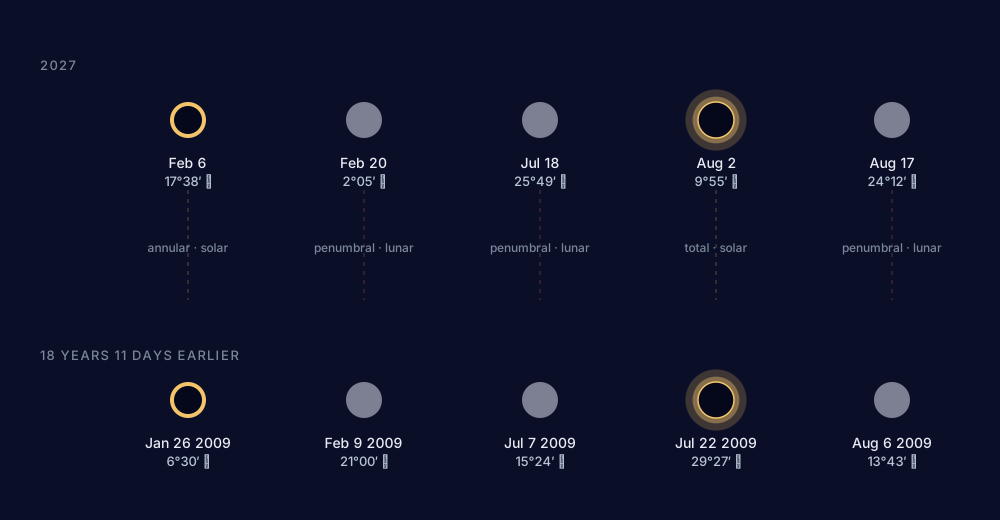
Eclipses repeat in families. After 18 years, 11 days and 8 hours (one Saros), the Sun, the Moon and the node return to nearly the same arrangement, and an almost identical one happens about 10° further along the zodiac. The total eclipse of 2 August 2027 is the return of the one on 22 July 2009, the longest totality of the 21st century.
Some astrologers use this as a memory aid: what began, ended or came to a head around the earlier member of the same family often returns as a theme. The tool shows each one's predecessor and successor. The figure pairs the five eclipses of 2027 with their echoes in 2009.
Families are born and die out. The faint one of 18 July 2027 is the last of its family: nothing follows it one Saros later. That is part of why it is so slight, with the Moon only grazing the edge of the Earth's outer shadow.
Every eclipse of 2027
Times are in UTC; the tool above shows them on your clock. The degree is that of the exact new or full Moon, the one astrologers quote.
| Greatest (UTC) | Eclipse | Degree | Node | Visible from |
|---|---|---|---|---|
| Feb 6, 16:00 | Annular solar eclipse | 17°38′ Aquarius | North, 3.3° | South America, Africa |
| Feb 20, 23:13 | Penumbral lunar eclipse | 2°05′ Virgo | South, 12.0° | South America, Europe, Africa, Asia |
| Jul 18, 16:03 | Penumbral lunar eclipse | 25°49′ Capricorn | North, 16.5° | Asia, Australia and the Pacific |
| Aug 2, 10:07 | Total solar eclipse | 9°55′ Leo | South, 1.6° | Europe, Africa, Asia |
| Aug 17, 07:14 | Penumbral lunar eclipse | 24°12′ Aquarius | North, 13.5° | North America, South America |
The total solar eclipse of 2 August 2027
The longest total eclipse seen from land until 2114 crosses the Atlantic, the Strait of Gibraltar, North Africa and Arabia. The path touches southern Spain and Gibraltar, crosses Morocco, Algeria, Tunisia and Libya, and reaches its longest totality, 6 minutes 23 seconds, in Egypt near Luxor, before crossing the Red Sea to Jeddah and Mecca and ending over the Horn of Africa and the Indian Ocean.
Astrologically it is a new Moon at 9°55′ Leo, less than 2° from the south node: the closest to a node in the Leo–Aquarius series. Leo is the sign of the heart, of play and of being seen; a south node eclipse is traditionally read as a release, letting go of something that has run its course. In your chart, look at the house that holds 10° Leo and at any planet near 10° Leo or 10° Aquarius.
Astrocartography adds a second question: does the path cross one of your planetary lines? Where the shadow runs over your Venus or Sun line, that place is said to be marked for you. With Pro, the map above draws your lines with the path and lists each crossing with the nearest city and the time the shadow passes.
How we calculate
The table comes from astronomy-engine, the same library behind our birth charts. We checked every eclipse from 2024 to 2032 against the Swiss Ephemeris: the times of greatest eclipse agree to within a minute (median 11 seconds; the table is rounded to the minute). The degree is the Sun's or the Moon's apparent position at the exact new or full Moon, the figure astrologers publish.
The paths of total, annular and hybrid eclipses are traced with the Swiss Ephemeris every two minutes, with the width of the Moon's core shadow at each point; the band on the map is that line widened, close to but not as exact as a published limit line. What you can see from a city is computed for that spot: the share of the Sun covered and the contact times for a solar eclipse, and which phases happen with the Moon above the horizon for a lunar one.
Houses are Placidus from your birth time, with the whole-sign house shown where it differs. A hit is a conjunction or opposition within 3°. Eclipses are listed to 2032, and the table is regenerated well before it runs out.
Eclipse questions
When are the eclipses in 2027?
2027 has 5 eclipses. February 6, 2027: Annular solar eclipse at 17°38′ Aquarius; February 20, 2027: Penumbral lunar eclipse at 2°05′ Virgo; July 18, 2027: Penumbral lunar eclipse at 25°49′ Capricorn; August 2, 2027: Total solar eclipse at 9°55′ Leo; August 17, 2027: Penumbral lunar eclipse at 24°12′ Aquarius.
Which house is the eclipse in my chart?
It depends on your birth time and place. It falls at one degree of the zodiac, and your houses divide the zodiac starting from your Ascendant. Enter your birth details in the tool on this page to see the house for every eclipse of the next three years, the opposite house on its axis, and any planet it lands on.
Is there a total solar eclipse in 2027?
Yes. The total solar eclipse of August 2, 2027 falls at 9°55′ Leo, with totality lasting up to 6 min 23 s near Luxor, Egypt.
How long does an eclipse's influence last?
Traditionally about six months, until the next eclipse season, and longer for a solar eclipse on a sensitive point. Some astrologers also watch the months around it, when a planet crosses the eclipse degree and triggers it. Effects are usually described as unfolding over time, not as a single day.
What does it mean when an eclipse hits my Sun or Moon?
An eclipse within a few degrees of your Sun is read as a turning point in direction and identity; on your Moon, in home, family and emotional life. A solar one there points to a start, a lunar one to a culmination. Most charts are hit somewhere in a two-year run of eclipses, so closeness matters: within 1° is strong, near 3° is mild.
Can I see the eclipse from where I live?
Choose your city in the tool. For a solar eclipse you will see whether it is total, annular or partial there, how much of the Sun is covered and the local times. A lunar one is visible from anywhere the Moon is above the horizon, and the tool shows which phases you will see. Never look at a partial or annular solar eclipse without eclipse glasses.
What is the difference between a north node and a south node eclipse?
The north node is traditionally linked with growth and what you are moving toward, the south node with release and what you are leaving behind. A solar eclipse near the north node is read as a push forward; one near the south node, like the total one of 2 August 2027, as a clearing out. The tool shows each one's node and how close it is.