Local Space Astrology
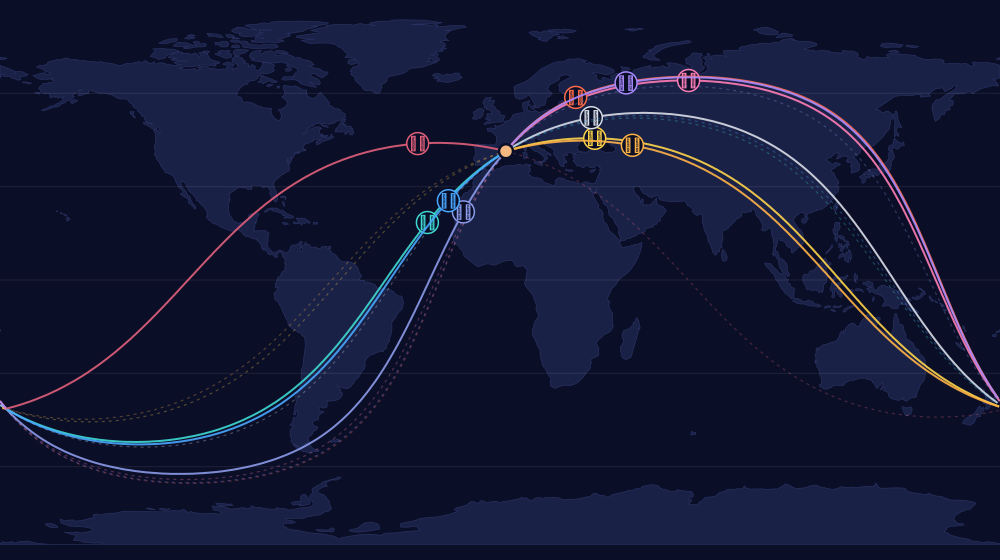
Your local space chart shows the direction of every planet at the moment you were born. Draw the lines from your birthplace or your home, zoom down to your street, and see which cities each one points at.
Example chart: born Jun 14, 1991, 7:30 AM in Barcelona. Enter your own birth details above.
Measured from Barcelona · Click anywhere on the map to measure from that spot
Outer ring: above the horizon at birth. Inner ring, dashed: below it.
| Planet | Direction | Altitude | Points toward |
|---|---|---|---|
| ☉︎ Sun | ENE 69°11° above the horizon | 11° above the horizon | … |
| ☽︎ Moon | NE 52°7° below the horizon | 7° below the horizon | … |
| ☿︎ Mercury | ENE 71°14° above the horizon | 14° above the horizon | … |
| ♀︎ Venus | NE 36°20° below the horizon | 20° below the horizon | … |
| ♂︎ Mars | NNE 34°23° below the horizon | 23° below the horizon | … |
| ♃︎ Jupiter | NE 34°23° below the horizon | 23° below the horizon | … |
| ♄︎ Saturn | SW 218°20° above the horizon | 20° above the horizon | … |
| ♅︎ Uranus | SW 235°3° above the horizon | 3° above the horizon | … |
| ♆︎ Neptune | SW 234°6° above the horizon | 6° above the horizon | … |
| ♇︎ Pluto | WNW 287°21° below the horizon | 21° below the horizon | … |
Large cities within 50 km of each line, in the direction the planet points, nearest first.
By the AstroChart team · Updated November 10, 2026 · Positions computed with astronomy-engine (NASA/JPL ephemeris accuracy)
What local space astrology is
Local space astrology turns your birth chart into directions. At the moment you were born, every planet stood somewhere in the sky around your birthplace: for example the Sun low in the west, Venus high in the south-east, Saturn below the horizon to the north. A local space chart records the compass bearing of each one, its azimuth, and treats that bearing as a line that leaves the birthplace and runs on around the Earth.
The technique is usually credited to the astrologer Michael Erlewine, who developed it in the 1970s, and it is read in two ways. At home, the lines tell you which part of a room, a house or a neighbourhood carries which planet. Across the world, they tell you which cities lie in the direction of your Venus or your Saturn. This page does both: the same chart drawn as a compass, as a table and as lines on a map you can zoom from the whole world to a single street.
Every number comes from the moment and place you were born. Change the origin to where you live now, or click any spot on the map, and the directions are measured again from there.
Local space and astrocartography are not the same map
Astrocartography asks where on Earth each planet was rising, setting or overhead. Its lines are fixed to the globe: your Venus line runs through the same cities wherever you live. Local space asks a different question, which way each planet stood from you, so its lines start from a point and radiate out from it like the spokes of a wheel.
That has a practical consequence. Move house and your astrocartography lines stay where they were; your local space lines move with you, because they are measured from wherever you are. This is why local space astrology is the one most used inside a home and around a city, while astrocartography is used to choose between countries.
The two work well together. Our astrocartography map draws the fixed lines, for choosing a country or a city; this page draws the lines that start from you, for finding your way within one.
Reading azimuth and altitude
Each row of the table gives two numbers. The azimuth is the compass bearing: 0° is true north, 90° east, 180° south, 270° west. The page shows it as one of sixteen compass points with the exact degree beside it, so "NE 47°" means a little east of north-east. The altitude is how high the planet stood: positive above the horizon, negative below it.
Local space is drawn from the azimuth alone. A planet below the horizon still has a direction, and its line is drawn the same way; the compass simply puts it on the inner ring. Many astrologers read planets above the horizon as more outward and visible, and those below as more private, but the direction itself does not change.
On the map, a line is a great circle: the straightest possible path on the Earth's surface. Over a few kilometres it is a straight bearing. Over thousands of kilometres it curves on a flat map, and it carries on all the way round the planet. The solid part is the direction the planet points; the faint dashed part is the opposite direction, which most astrologers read as part of the same line.
When a planet's bearing falls within two degrees of north, east, south or west, the table marks it as due north, due east, due south or due west. These cardinal alignments are read as especially strong: the planet lines up with the main axes of the place itself.
What each planet's direction means
These are the traditional readings of each direction, at home and further away. Use them as prompts rather than rules.
☉︎ Sun
At home
The direction for a desk, a front door or anywhere you want to be seen and to feel like yourself.
Further away
Places in this direction can bring recognition and confidence; good for work trips and fresh starts.
☽︎ Moon
At home
The direction for the kitchen, the bed or a quiet corner: comfort, family and rest.
Further away
Places this way feel like home quickly; good for visiting family or settling in.
☿︎ Mercury
At home
A study, a phone corner or a bookshelf: talking, writing and thinking clearly.
Further away
Good for short trips, courses, interviews and anything that runs on conversation.
♀︎ Venus
At home
The living room, the bedroom or where you entertain: beauty, pleasure and ease.
Further away
Places in this direction suit love, friendship, art and holidays.
♂︎ Mars
At home
A gym corner, a workshop or a door you use to go out and act. Not the bed.
Further away
Energy and drive, sometimes conflict; good for challenges, sport and competition.
♃︎ Jupiter
At home
Anywhere you want growth: a study, a guest room, the place you plan from.
Further away
The classic lucky direction: travel, study, generosity and opportunity.
♄︎ Saturn
At home
A desk for long, serious work, or storage. Rarely the bedroom.
Further away
Duty, structure and hard work; good for building something lasting, heavy for a holiday.
♅︎ Uranus
At home
A space for experiments and change, where you try new things.
Further away
Sudden change and freedom; exciting places, rarely restful ones.
♆︎ Neptune
At home
A meditation corner, music, or the bath: dreams, imagination and retreat.
Further away
Inspiration and spirituality, also confusion; good for retreats, not for contracts.
♇︎ Pluto
At home
Where deep work and letting go happen: therapy, clearing out, research.
Further away
Intense, transforming places; powerful, rarely light.
Using local space at home
Stand in the middle of your home with the compass and you can map each planet onto a room, a wall or a corner. The usual approach is to support what you want: put the desk on your Sun or Jupiter line, the bed on your Moon or Venus line, and keep the bed off Mars and Saturn. On the street view of the map you can see the same lines running through your own building and the streets around it.
Two things decide how precise this can be. The first is where you measure from: click the exact spot of your home on the map, rather than using the city centre, and the lines move to your address. The second is your birth time, which matters less here than almost anywhere else in astrology, as the next sections show.
Treat this as a way of arranging a space with intention, like any other design choice. It is not a substitute for light, safety or comfort, and no direction is bad enough to give up a room you love.
Cities and travel: where each line points
Followed far enough, every local space line passes through other places. The table lists the first large cities each line meets in the direction the planet points, within 50 km of the line, with the distance from your origin. The same planet sends its line through quite different countries from different birthplaces, which is why two people born on the same day can have their Venus pointing at opposite ends of a continent.
Astrologers read these as directions for travel and for relationships with places: a city on your Jupiter line is somewhere that tends to bring opportunity, one on your Saturn line somewhere that asks for effort. Measure from where you live now and the list changes, which is often the more useful version: it tells you which way to travel from here.
If you are choosing a city to live in, combine this with our best places to live ranking, which uses astrocartography to score cities for love, career, wealth, health and growth.
What 1,000 simulated births show
To see how local space behaves for real charts, we ran it for 1,000 simulated births between 1950 and 2005, each born in a random city of 250,000 people or more. Three results are worth knowing.
34 m
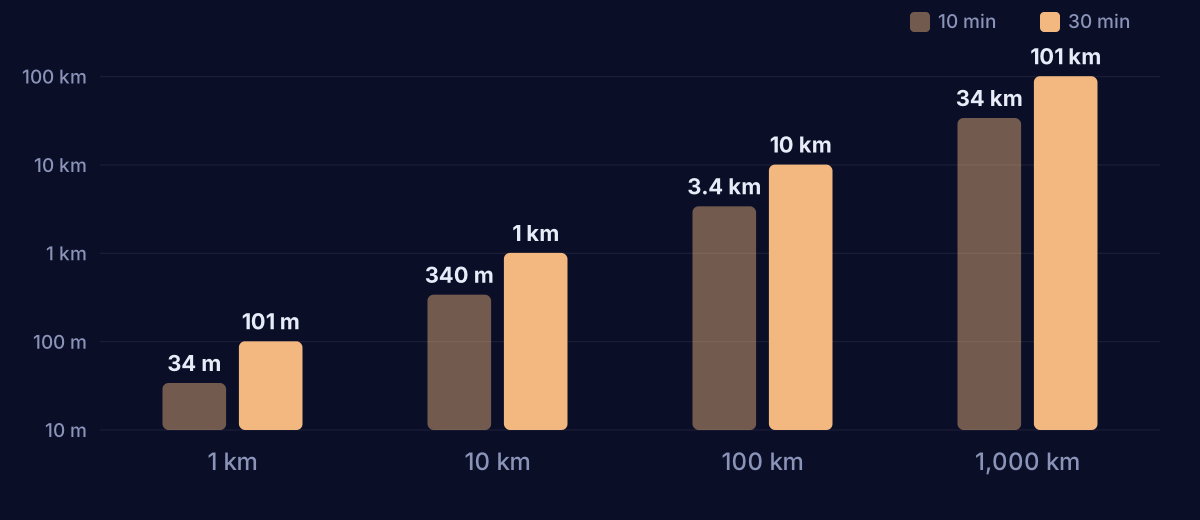
A birth time 10 minutes off turns a typical line by 1.9°. A kilometre from home that is 34 metres sideways, a few houses; a thousand kilometres away it is 34 km.
36.4%
Of the charts, 36.4% had at least one planet within 2° of due north, east, south or west, the alignments the table marks.
6.5°
Moving about 1,000 km turned the lines by a median 6.5°, and 30.4% of them by more than 10°. Your home's chart is not your birthplace's.
Each line, followed in the direction its planet points, met a median of 7 large cities on its way round the world; only 4.2% met none.
Birth time: forgiving at home, strict far away
A birth time error turns every line a little, because the sky turns one degree every four minutes. For local space the effect is small near the origin and grows with distance. In our simulation, a 10-minute error turned a typical line by 1.9°, and a 30-minute error by 5.8°.
At home scale that is almost nothing: a 30-minute error moves a line about 101 metres at a kilometre from home. At travel scale it adds up: the same error moves it about 101 km at a thousand kilometres. So a birth time remembered as "around three" is good enough for arranging a flat, and worth checking before you read the list of cities.
If you don't know your birth time at all, the lines can't be placed: every planet goes all the way round the compass once a day. This tool needs a birth time.
Frequently asked questions
What is local space astrology?
Local space astrology reads your birth chart as directions: the compass bearing of each planet at the moment you were born, drawn as lines that leave your birthplace and run around the world. It is used at home, to see which part of a space carries which planet, and for travel, to see which cities lie in each planet's direction.
How is local space different from astrocartography?
Astrocartography lines are fixed to the globe and show where each planet was rising, setting or overhead. Local space lines start from you and show which way each planet stood, so they move when you move. Astrocartography helps choose between countries; local space works inside a home and around a city.
Can I use local space for my current home?
Yes. Enter where you live now, or click the exact spot of your home on the map, and every direction is measured again from there. The chart uses the moment you were born, seen from that point.
Do I need my exact birth time for a local space chart?
You need a birth time, but local space forgives small errors near home. In our simulation a 10-minute error moved a line about 34 metres at a kilometre from home, and about 34 km a thousand kilometres away.
What does it mean if a planet is below the horizon?
It still has a direction, and its line is drawn the same way. Many astrologers read planets below the horizon as more private and inward, and those above as more visible. The compass puts them on the inner ring.
Is this local space chart free?
Yes. The chart, the compass, the table, the map with street view, measuring from your home or any pin, and the cities along each line are all free. Nothing is saved.
Why do the lines curve on the map?
Each line is a great circle, the straightest path on a sphere. Over a few kilometres it looks straight; over thousands of kilometres a flat map has to bend it. It carries on all the way round the Earth and comes back to the point opposite yours.